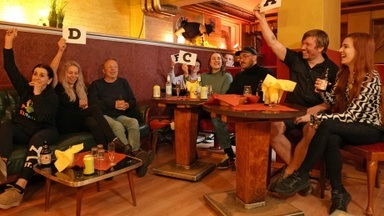
PHOTO: © Heimvorteil
400 Jahre Reeperbahn – 400 Jahre Wandel
Hamburg

In the organizer's words:
This year, St. Pauli is celebrating “400 Years of the Reeperbahn.” And we’ll be joining Eva Decker on several tours to mark the occasion.
In 2026, the St. Pauli Office will host regular readings, lectures, and guided tours that highlight developments in St. Pauli from the 17th century to the present. The lectures are divided into four parts—details are provided below. One focus is on the theme of “displacement,” as this is how the history of the famous Reeperbahn in St. Pauli began: In 1626, the rope makers were forced to move from Hamburg to what is now St. Pauli due to the newly constructed ramparts; there, they were in turn displaced at the end of the 19th century by the rapidly growing urban entertainment and working-class district.
Another program addresses questions such as “Was everything better in the past? Or do some things never change?”
Accompanied by historical texts and images from the 18th, 19th, and early 20th centuries, there is a separate program for each era.
Part 1: St. Pauli in the 17th and 18th Centuries – Lecture with guided tour on March 1 & March 15
Part 2 “Suburban Walk: St. Pauli Two Hundred Years Ago”: Lecture with guided tour June 7
This evening is dedicated to 19th-century St. Pauli: It begins with a visual panorama of a rural Reeperbahn idyll from the year 1826. We’ll stroll through the greenery, visit the fair on Spielbudenplatz, the “dance halls with girls,” and enjoy ourselves at the summer theater—until a new era rapidly transforms the face of the suburb and St. Pauli takes on its modern character. And so we finally end up on a glamorous entertainment boulevard in the midst of a bustling urban district, where there is no longer any room for the “Reepschläger.” In 1883, they were forced to leave.
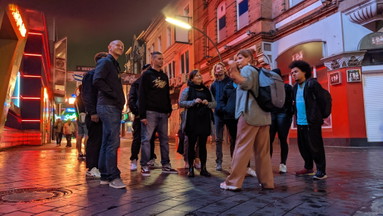
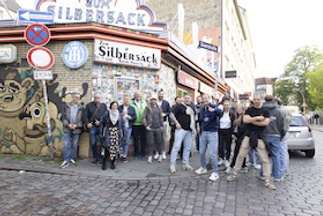
The event begins with a lecture lasting approximately 45 minutes. This is followed by a roughly 90-minute walking tour of the sites featured in the stories we’ve just heard. Our “guides” are a lithograph by Peter Suhr (created around 1826), historical texts, and Eva Decker.
Part 3 “The Dance of Beauty and Street Fights. St. Pauli a Hundred Years Ago”: Lecture with walking tour on August 2, August 30, and September 20.
Just how “golden” were the 1920s in St. Pauli? The third event in the historical series celebrating 400 years of the Reeperbahn is dedicated to this question. This time, historical travel guides from the 1920s open a window onto St. Pauli during the Weimar Republic—a time when the neighborhood became both the scene of and a battleground for social and political unrest: While in the Reeperbahn’s variety theaters, scantily clad dancers glide across the stage before an audience hungry for entertainment, outside the doors people are struggling just to survive.
The event begins with an approximately 45-minute lecture on the area that is now St. Pauli as it was one hundred years ago. This is followed by an approximately 90-minute walking tour to the sites featured in the stories just heard.
Part 4 “What Has Remained”: Lecture with Walking Tour on October 11 & November 8
Just in time for the end of the year, we conclude our series with a summary and the question, “400 Years of Change—What Has Remained?” We’ll begin by finding an answer in architectural remnants from various centuries, which we’ll (re)discover on our walk from the upper to the lower end of today’s Reeperbahn.
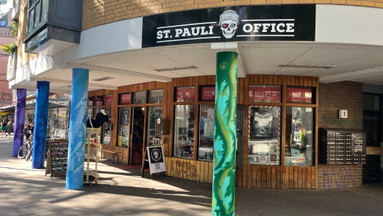
Following these external impressions, we’ll delve deeper in the basement lounge of the St. Pauli Office to explore further constants, such as those found in descriptions and images of St. Pauli from the 19th century to the present. A slide presentation will address questions such as: What has changed—and what has remained the same? What merely appears different—yet is simply the familiar with a new face? Was “everything better in the old days?” or “do some things never change?”
With an opportunity for conversation and a toast, we’ll conclude our “400 Years” series with a “Cheers to the Reeperbahn!”—and look forward to the Advent season.
Price information:
Cost: 27 EUR per person (22 EUR reduced rate)
Location

Accessibility information
You can find everything about accessibility at Rausgegangen here.
Weitere Termine von 400 Jahre Reeperbahn – 400 Jahre Wandel
You might enjoy this as well?












Noch mehr Events dieser Location-Page