beSCHÖNigen - eine thematische Gruppenausstellung.
In the organizer's words:
beSCHÖNigen - a thematic group exhibition of contemporary art dealing with the inevitable and recurring.
Between longing and denial, poetry and provocation.
:::
Open until March 8, 2026
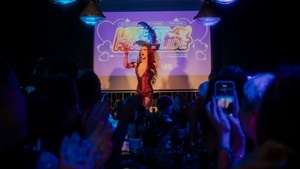
Saturday, February 21 at 7 pm Performance by SkullMari
:::
Participating artists:
Hermann B., Fernando de Brito + Peter Nikolaus Heikenwälder, Florian Wiese, Frerike Nagels, Güde Renken, Hanna Gajare, Hannah Uhlmann + Christina Kampmann + Eva-Maria Weikert + Nora von Zahn, Ide Ha, Klaus Möller, Luka Topp, Marion Meinberg, Mikhey Lyskov, Petra Höcker, SkullMari, tomko family
:::
For the beautiful new year, we once asked: "Do the fine arts trivialize or are they instrumentalized - whitewashing, whitewashing, romanticizing - is it the aesthetic that trivializes - do we make our lives look more glamorous than they are, do we need a bit of an ideal world to avoid despair - or do we want to play down the complexity with beautiful moments to pass on responsibility - or do they open up new horizons for us." That was our philosophical sketch of ideas in the call for entries. From over 70 submissions, we curated 15 answers for the first thematic group exhibition of the year:
HANNA GAJARE explores the boundaries between real places and their imaginative, painterly dissolution in the oil works of the "DRIFT" series, which she has been working on for almost a decade. Emerging landscapes are transformed into autonomous spatial structures, they begin to slip, dissolve and reform as floating, idiosyncratic spaces.
Influenced by a family background as a refugee, which had a lasting effect on her view of the world, in search of beauty in the world beyond the visible and the perception of what is not visible to the naked eye, the works move between memory, longing and the invisible and tell of places that did not and do not exist, but which continue to exist as inner topographies.
SKULLMARI understands the title of the exhibition as an ironic game. Her contribution to the theme is the tension between the beautiful, the ugly and the painful, also receptively. A woman's legs, marked with bruises, can be seen on a beautiful but also kitschy sky background. The colors of the sky make the colors of the stigmata almost disappear for our perception. The irritation, including that of the algorithmic dilettantism of the image editing app, which has been given free rein, is intentional.
On February 21, the duo will perform "Nonyesno ", a performance about misunderstandings and ambivalences that moves between stimulus and reaction: Is it always clear what the other person wants? Are we always clear about what we want ourselves?
HERMANN B. 's instant photo series "Geröllberge" was created in 2021, when, after clearing and re-clearing work in the Ahr valley, man-made mounds created a sometimes bizarre landscape spread across the maltreated valley. In front of the autumn-colored vineyards, they appeared as part of an idyllic landscape.
MIKHEY LYSKOV 's photographic series deals with the reduction to the natural and everyday, to light. Here, light is seen as something alive, because light moves, shifts, touches the paper and leaves its traces. Lyskov invites us to consciously perceive the self-evident and everyday again.
MARION MEINBERG 's series "Du steckst nicht in meiner Haut." is also about conscious perception and acceptance in a silent confrontation with interventions that may be medically or psychologically necessary. Between vulnerability and the desire for perfection or "normality" (?) lies the sentence: My body belongs to me.
FLORIAN WIESE is also concerned with questioning changes and their foundations, albeit in a completely different way. You could say, he asks, that when we embellish we add something to the matter/the object. But is that really the case? Or is it not very similar to its supposed opposite (badmouthing) in that it blocks access to the truthfulness of the matter and thus constricts it?
With a subtle combination of everyday things in "Alte Zöpfe",IDE HA would like to invite us to make associations and ask which things and habits we should turn to and which we should part with.
LUKA TOPP 's works also show everyday materials in pastel chalk on canvas. In this case, plastic bags as aesthetic phenomena. While on the one hand it is about a conscious reconsideration with a focus on structures, reflections and transparencies, drawing attention to qualities that are hardly noticed in everyday use, on the other hand it questions how quickly we are prepared to ignore negative aspects when something visually seduces us.
KLAUS MÖLLER is also concerned with the second glance. With the images of wilted flowers on the kitchen table at home, he attempts to "drill a hole in a paradoxical everyday practice": The seemingly self-evident connection between nature and beauty shows a human need, he says. However, it perhaps also shows that a genuine encounter with nature is avoided because it could be associated with a loss of control.
Juxtapositions run through the works of HANNAH UHLMANN. What remains of handwork and care when the material itself is no longer available? A hand-crocheted textile with the word "soft", a technique associated with care, repetition and physical knowledge, is dipped in porcelain and fired. What remains is a fragile shell that preserves only the structure.
Another group work together with CHRISTINA KAMPMANN, EVA-MARIA WEIKERT and NORA VON ZAHN addresses historically invisible care work and its gender-specific exploitation and repositions knitting as a political and artistic medium that breaks with traditional role models and creates social connection.
In their works "en passant" and "compressed romance ",FERNANDO DE BRITO and PETER NIKOLAUS HEIKENWÄLDER both deal with the correction or glossing over of given conditions. To this end, De Brito reworks masterpieces printed in drawings and thus gives these works a new face of their own. Heikenwälder's scans of pressed flowers undertake something like an attempt at reanimation and thus achieve something lively, at least at first glance. Both series are based on the floral theme, something naturally beautiful, but which had already suffered a loss before the artistic interventions of de Brito and Heikenwälder. Perhaps they are successful corrections, or perhaps they are embellishments.
PETRA HÖCKER'sartistic practice deals with the themes of vulnerability and transformation. In paintings, objects and installations, she examines the fundamental states of being human and exposes layers of body and soul. Protective shells are removed to reveal inner states and processes. These inner depths find expression in forms, materials and gestures. The result is often raw, fragmentary and arises from an interplay of expressive expressions and controlled chance.
The diptych "cut the lawn together" by GÜDE RENKEN is about a smoothly ironed outside world, about order and control where change and uncertainty actually prevail. The accurately mowed lawn and the satisfied observer stand for a need for perfection and stability in everyday life and are in contrast to the wild and disorderly, which is also evident in the stroke, and at the same time appears more lively.
FRERIKE NAGELS writes about her objects "Don't meet me on the way home or just change sides of the street" made of fabric and ceramic "I lock the door and turn around. Was someone there or is that just a shadow? My bunch of keys and my kitchen knives act as an interface between my home and the public."
Drones can also do many things: threatening, spying and bombing anyway. Perhaps also: love. The TOMKO FAMILY applied with the series "drones of ...(...maybe love)" precisely because it became clear to them that the title of their work must be seen as an inappropriate euphemism, and went into the public space with paper cut-outs.
ware software platform, which uses piezo elements as sound sources and works with two microcontrollers. Originally developed in collaboration with Sergey Kostyrko for the interdisciplinary project ПУСТ*, it has since been used in performance contexts and is now being presented for the first time in installation mode as part of a group exhibition.
:::
If you have any questions, please contact us; if you are thirsty, too. We don't offer anything we wouldn't drink ourselves, drinks are available for a donation. Free admission, because everyone should have access to culture. However, you are welcome to make a donation if you would otherwise honor it. We conceive these exhibitions and run this space because we think it is important that there are constant and challenging positions between state museums and commercial galleries on the one hand and changing platforms for emerging art on the other - on the one hand to better promote artists, and on the other to create a more vibrant culture for the dialog between art and society. We mix established artists with newcomers. What interests us is the quality and the potential. If you would like to support this work, please contact us - or simply recommend us to others.
The narratives in this exhibition were created by the artists. The text was edited by Gerald Chors.
:::
Duration:
Thursday, February 5, 2026 to Sunday, March 8, 2026
Opening hours:
Saturdays, Sundays, Mondays and Tuesdays 6 - 9 pm (and by appointment)
Vernissage:
Thursday, February 5, 2026 at 7 p.m.
Finissage:
Sunday, 8.3.2026 11 a.m. - 4 p.m.
Special date:
Performance SkullMari on Saturday, 21.2.2026 at 7 pm
Venue:
xpon-art gallery
Repsoldstraße 45
20097 Hamburg
www.xpon -art.de
:::
We will inform you about deviating opening hours on our homepage, our Instagram account @xponartgallery and our Facebook page facebook.com/xponart
After the exhibition, 360° views will be added to the homepage, especially for those who are unable to visit.
Despite everything, we ask you to think about Corona and the flu epidemic and to behave accordingly.
:::
With the kind support of the Hamburg Ministry of Culture and Media
:::
This content has been machine translated.Price information:
Free admission, because everyone should have access to culture. However, you are welcome to make a donation if you would otherwise honor it. Drinks are available for a donation. We don't offer anything that we wouldn't drink ourselves. We conceive these exhibitions and run this space because we think it is important that there are constant and challenging positions between state museums and commercial galleries on the one hand and changing platforms for emerging art on the other - on the one hand to better promote artists who are not yet established, and on the other to create a more vibrant culture for communication between art and the public.
Location
You might enjoy this as well?




Events near you
Activities near you
Popular event locations
The best event recommendations for the Rausgegangen App!

Gemeinsam Events erleben
Events werden noch schöner wenn wir sie teilen! Deshalb kannst du dich jetzt mit Friends und anderen Usern vernetzen um Events gemeinsam zu besuchen. Loslegen