In the organizer's words:
Fri 8.11., 18h, guest: Heide Schlüpmann, on the grand piano: Eunice Martins
DIE FÄCHERMALERIN Rudolf Meinert D 1913 35 mm silent 39'
HILDE WARREN AND DEATH Joe May D 1917 51'
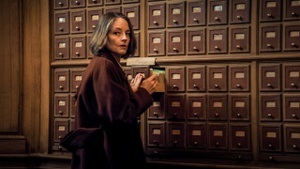
During the five years that Jay Leyda lived in East Berlin with his wife, the Sino-Caribbean dancer and choreographer Si-lan Chen, and worked at the GDR State Film Archive, he also regularly crossed Checkpoint Charlie for viewings at the Deutsche Kinemathek. He shared a passion for early cinema with its director and founder, the film collector Gerhard Lamprecht. During one such visit, Leyda saw Rudolf Meinert's socio-critical melodrama DIE FÄCHERMALERIN. With cross-fades, accentuating lighting and a short film-within-a-film animation in which a fan painting becomes a confession of love, this film is still a great pleasure to watch today. It tells the story of a young woman whose father is serving a long prison sentence for treason and who from then on has to support herself and her sickly mother by working from home. The film's formal experiments are artfully used to visually narrate changing social and gender relations full of conflict, as film scholar Heide Schlüpmann explained in an analysis of the film in Unheimlichkeit des Blicks (1990).
Jay Leyda was instrumental in the rediscovery of May's HILDE WARREN UND DER TOD and its reconstruction in the SFA in 1965. He maintained correspondence with Fritz Lang, who had written the screenplay for HILDE WARREN and was still in contact with Mia May, who played the title role. Lang and May were willing to help from a distance in reconstructing the film, which had been found "in an unedited chaos" (Leyda to Lang), but could hardly remember it. Although the correspondence suggests that Leyda finally succeeded in reconstructing the film at the SFA, it is now considered to be only incompletely preserved and was digitally restored a few years ago by the Friedrich Murnau Foundation. Mia May plays a stage actress, spoiled by success and full of life, who struggles with having to portray a woman who is tired of life in a new play. However, her demonstrative lack of interest in death makes it seem personal and from then on she never leaves her side.






Events near you
Activities near you
Popular event locations
The best event recommendations for the Rausgegangen App!
