PHOTO: © Andrea Dilzer
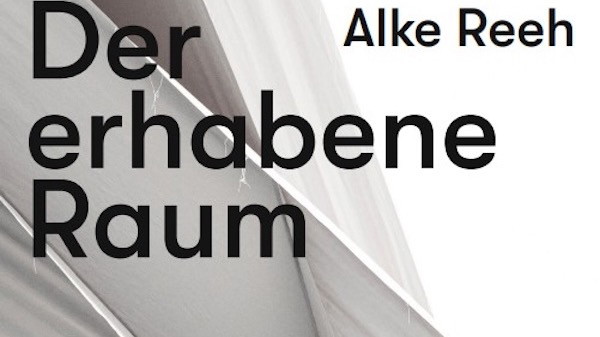
Finissage + Artist Talk: Der erhabene Raum
So, 08. Nov 2026
15:00 - 17:00
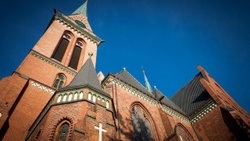
Kulturkirche Bremerhaven
Bremerhaven
In the organizer's words:
Artist Alke Reeh speaks with curator Dr. Lena Reichelt about her work and the creation of the exhibition.
In her exhibition*Der Erhabene Raum* (The Sublime Space), Alke Reeh translates these distinctive features of the interior of the Kulturkirche Bremerhaven into a remarkable, large-scale installation that makes the sublime tangible and opens up new levels of perception and reflection. Designed as a sacred space, the church interior is intended to take people beyond their usual frame of reference. Monumental dimensions, vertical lines, and a clear orientation toward the altar create a sense of a greater order. Visitors experience themselves as small and, at the same time, as part of a larger whole.
It is precisely in this tension that the experience of the sublime lies, as Friedrich Schiller described as early as 1793:“The feeling of the sublime is a mixed feeling. It is a combination of sorrow, which in its highest degree manifests as a shudder, and of joy, which can rise to the point of rapture […].“ According to Friedrich Schiller, therefore, the sublime is a state in which a person experiences the limits of their sensory existence and yet recognizes their spiritual freedom. The sublime arises where the imagination reaches its limits, yet the spirit points beyond them.
Alke Reeh impressively translates this sensory experience and spiritual freedom—the unique combination of transcendence and atmosphere within a sublime, sacred space—into the material realm in her work. Scaffolding poles rise into the space like Mikado sticks. Monumental yet dynamic, they echo the fundamental idea of sacred church architecture: the striving for height, expansiveness, and an opening toward the infinite. Individual panels of fabric, some overlapping, are stretched between the poles. At first glance, they appear to hold the structure together, yet in fact they move with ethereal lightness between the massive elements. They seem like rays of light rendered tangible, lending the scaffolding poles an unexpected weightlessness.
Light plays a central role in Alke Reeh’s work. Inside the church, it streams through the tall windows, pierces the solidity of the walls, and transforms the space into a vibrant interplay of brightness, reflection, and shadow. Yet it is far more than a physical phenomenon: It becomes a vehicle of meaning. In the fabric panels, the light takes on a tactile, ever-present form. They direct the gaze through the poles toward the height and expanse of the space, dissolving the boundaries of the tangible and pointing to a reality beyond the visible. This creates a unique, immaterial spatial effect that transforms the church interior into a spiritual realm and reveals the sublime as an interplay of sorrow and joy.
Alke Reeh studied metal design at the University of Applied Sciences in Hildesheim and fine arts at the Düsseldorf Art Academy as a master’s student under Prof. Klaus Rinke. She has participated in numerous fellowship programs in Germany, France, Saudi Arabia, India, and China, as well as in numerous group and solo exhibitions both domestically and abroad. In addition to numerous other awards, she won the “Die Grosse” NRW Düsseldorf Artists’ Art Prize in 2024. Her medium is sculpture, and she experiments with various materials such as porcelain and plaster, but especially with fabric. A central focus of her work is the exploration of structures and processes in space. Alke Reeh lives and works in Düsseldorf.
Location
Accessibility information
We don't have any accessibility information for this event.
You can find everything about accessibility at Rausgegangen here.
You might enjoy this as well?




Noch mehr Events dieser Location-Page