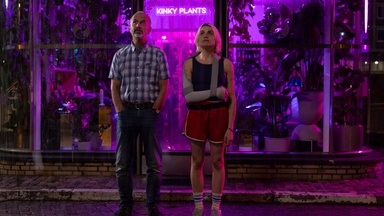
PHOTO: © Extra tropical (yucca), film still (c) Nicolas Carrier & Marie Ouazzani
FOOD & FOOTAGE X Food Cultures: A Triangular Liquid City, Where Bodies and Spices Circulate

In the organizer's words:
This issue of FOOD & FOOTAGE looks at the vastness of the oceans not as continental dividing lines, but as flowing infrastructures that connect distant regions. Based on the historical displacement of entire populations around the globe, we show that colonization is an ecological and urban appropriation: cities are just as movable as cultures. The program decenters Eurocentric narratives of migration by situating them between anthropology and the Anthropocene, where the movement of human bodies converges with the flow of seeds, food and sediment.
Linking this broad history to the migrant and Arab diaspora in Moabit, FOOD & FOOTAGE uses cinema and shared culinary practices to explore how migrating ingredients become living architectures of memory, survival and community building.
Films
Extra tropical (arecaceae) / (yucca) / (hevea) / (opuntia)
by Nicolas Carrier & Marie Ouazzani
6'22'' / 6'28''/ 6'24''/ 6'18''
France, 2020-22
French/Portuguese/Dutch/Italian with English subtitles
In Extra tropical (arecaceae), the palm trees of the port of Brest remind us that they were already present in the Oligocene and powerlessly contemplate their exploitation by the agri-food industry for the production of palm oil. They dream of a Europe that has become tropical again in the more or less near future. Extra tropical (yucca) focuses on the yuccas in the port of Lisbon and regards these plants of American origin as traces left behind by the intensive voyages of the triangular trade. Extra tropical (hevea) focuses on the rubber trees of the port of Antwerp and their role in the exploitation of the former Belgian colonies in Africa by the chemical and automotive industries for the rubber they produced. In Extra tropical (opuntia) , the nopales of the port of Genoa tell us about their spread through sea transportation. Faced with the recent explosion of mass tourism and cruises, they dream of being refuges to face the ecological crisis.
Quem me encontrar parado me empurre para o meio
by Alina d'Alva Duchrow
3'12''
Brazil, 2018
Portuguese/Spanish with English subtitles
Whoever finds me standing still pushes me into the middle - this was the phrase that was often written on the small wooden boats that migrant workers who set off into the forest without knowing whether they would ever return home used as a means of communication and as a sign of faith. The people from Ceará, who lived in exile in the Amazon region, threw the boats into the river to keep promises they had made to Saint Francisco de Canindé in moments of despair. In the video, the artist reads aloud a letter written by a woman who lived in the Amazon at the beginning of the 19th century, addressed directly to São Francisco, as we see her propelling a boat down the river. This represents the desire to safeguard the flow of memories, in an explicit refusal to erase them, thus avoiding future shipwrecks.
A Semente
by Alina d'Alva Duchrow
17'58''
Brazil, 2022
Portuguese/Spanish with English subtitles
The screening is free of charge; the purchase of a dinner is not a prerequisite for attending the movie night. Thanks to the generous support of QM Beusselstraße, the menu at this event is available on a donation basis (drinks not included). For better planning, we kindly ask you to reserve a free ticket.
Admission: 19:00
Dinner: 19:30
Film starts: 20:30
This edition of FOOD & FOOTAGE is sponsored by Aktionsfond QM Beusselstrasse.
Location
You might enjoy this as well?






Noch mehr Events dieser Location-Page