Heute noch, morgen schon – Filmische Perspektiven auf Berlin um 1990
In the organizer's words:
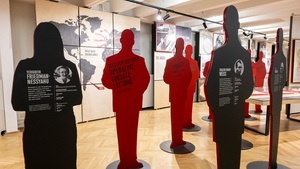
35 years after the end of the division of Germany, the Stadtmuseum Berlin is dedicating a major film exhibition in the Museum Nikolaikirche to the upheavals in Berlin around 1990.
Documentary short films, film and television clips from four decades provide rare insights into the far-reaching changes. People in East Berlin in particular experienced the storm of events as contradictory: on the one hand, self-empowerment, gaining freedom and the promises of the market economy; on the other, insecurity, job losses and violence against people who were perceived as different. At the same time, artists in the exhibition deal with those years from today's perspective. They look at the spatial and social continuities as well as the ruptures in a city that embodies the political history of Europe in the 20th century like no other.
Hopes and disappointments
On January 11, 1991, a decision was made in the Museum Nikolaikirche about the Berlin constitution. However, living together is not only determined by the democratic values formulated therein, but above all by everyday life, the economy, architecture, as well as cultural affiliations and structural inequalities. The exhibition offers space for a look at a time full of hopes and disappointments: for personal stories, experiences and perspectives that were often not heard or suppressed.
For example, what did the outbreak of nationalism and xenophobia after the fall of the Berlin Wall mean for people with a history of migration in West and East Berlin? Heute noch, morgen schon" deliberately highlights events that are not remembered or are remembered differently. These include, for example, the monetary, economic and social union on July 1, 1990, when the inner-German border controls were abolished.
The several hours of film material is embedded in a scaffolding landscape in the museum with a total of nine large-format screens. Visitors are invited to immerse themselves in cinematic moments of real life. The filmmakers' practice ranges from participant observation and open discussion to the artistic appropriation of history and the present. A journey of discovery through a past and ever-changing Berlin.
With films by:
Juliet Bashore | Kerstin Bastian | Konstanze Binder, Lilly Grote, Ulrike Herdin, Julia Kunert | Ludger Blanke | Tsitsi Dangarembga | Jochen Denzler, Lew Hohmann, Petra Tschörtner, Hans Wintgen | Johann Feindt, Jeanine Meerapfel, Helga Reidemeister, Dieter Schumann, Tamara Trampe | Nele Güntheroth, Thomas Hahn | Kerstin Honeit | Brenda Akele Jorde | Riki Kalbe | Ingo Kratisch, Jutta Sartory | Betina Kuntzsch | Angelika Nguyen | Pınar Öğrenci | Helga Reidemeister | Pim Richter, Karl Farber | Elske Rosenfeld | Bernd Sahling | Volker Sattel | Viola Stephan | Petra Tschörtner | Chetna Vora
Curated by Florian Wüst in collaboration with Suy Lan Hopmann
Scenography: HMDMR [hamdemir], Bahadir Hamdemir
Media production: PxB Studios, Jana Pausinger, Alexander Bartneck
The exhibition is accompanied by a publication edited by Elke Neumann.
In cooperation with Deutsche Kinemathek - Museum for Film and Television
With the kind support of Arsenal - Institute for Film and Video Art, Filmuniversität Babelsberg KONRAD WOLF and PROGRESS Film
In addition to the program of events at the Museum Nikolaikirche, an accompanying film series will take place in cooperation with Arsenal - Institute for Film and Video Art, Büro für Dramaturgie, Gropius Bau, neue Gesellschaft für bildende Kunst (nGbK) and Stadtteilzentrum KREATIVHAUS on Fischerinsel.
Price information:
7 euros (single ticket) | 15 euros (combined ticket*) | Free admission (under 18s or with concession * Applies to our three museums in the Nikolai Quarter (Museum Nikolaikirche, Museum Ephraim-Palais, Museum Knoblauchhaus) on two consecutive days.
Location
You might enjoy this as well?


Events near you
Activities near you
Popular event locations
The best event recommendations for the Rausgegangen App!

Gemeinsam Events erleben
Events werden noch schöner wenn wir sie teilen! Deshalb kannst du dich jetzt mit Friends und anderen Usern vernetzen um Events gemeinsam zu besuchen. Loslegen