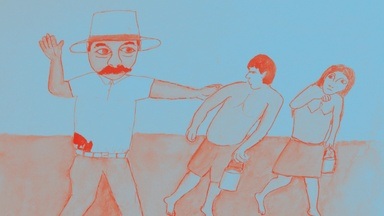
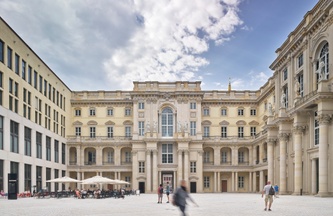
PHOTO: © Stiftung Humboldt Forum im Berliner Schloss / Giuliani von Giese
Krieg erzählen: Lesung mit Ronya Othmann und Ela Pour
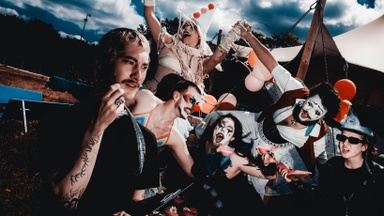
In the organizer's words:
How can we talk about war - with images, with words? And how is it possible to recount experiences of violence and loss?
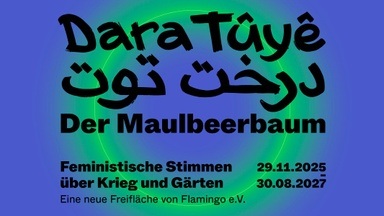
The reading at BERLIN GLOBAL accompanies the open-air exhibition "Dara Tûyê - درخت توت - The Mulberry Tree", which brings together feminist voices about war and gardens and makes visible the solidarity of women across geographical and political borders. The exhibition shows gardens as places of remembrance, healing, self-empowerment - but also of resistance against oppression and violence.
Against this backdrop, two artistic voices meet:
Ronya Othmann reads from her texts "Vierundsiebzig" and "Rückkehr nach Syrien", in which she tells of the war in Syria and the genocide of the Êzid*innen. She explores the traces that these experiences leave behind in people and landscapes. Her literature combines personal memories with political realities and provides direct, penetrating insights.
Ela Pour brings a lyrical and visual perspective. Together with other tattoo artists, her autobiographical book project explores the questions of which images evoke experiences of war and resistance and how these can be expressed artistically. Her work shows how art can help people to assert themselves, heal and make stories visible in a different way.
Boussa Thiam moderates the evening and invites the two artists to talk together about how war can be told - literarily and visually.
PARTICIPANTS
Ronya Othmann, born in Munich in 1993 to a German mother and a Kurdish-Ezidi father, writes poetry, prose and essays and works as a journalist. She has received many awards for her writing, including the Open Mike Poetry Prize, the MDR Literature Prize and the Caroline Schlegel Prize for Essay Writing. She was awarded the Mara Cassens Prize in 2020 for "Die Sommer", her first novel, and the Orphil Debut Prize, the Horst Bienek Prize and the Horst Bingel Prize in 2022 for her poetry collection "die verbrechen" (2021). "Vierundsiebzig", her second novel, was nominated for the German Book Prize and awarded the Düsseldorf Literature Prize, the SWR Best List Prize in 2024 and the Erich Loest Prize in 2025.
Ela Pour was born in Tehran in 1975. She spent her early years in England before returning to Iran. In 1989, the war brought her to Germany, where she continued her passion for art and music from an early age and made them central forms of expression in her life. She studied costume and stage design at the Kunsthochschule Berlin-Weißensee, where she graduated with a diploma. Her works as an artist and tattooist move between memory and the present. In them, personal experiences are condensed into poetic images that make both vulnerability and resilience visible.
Boussa Thiam is a cultural journalist, presenter and speaker. She presents the cultural program on WDR COSMO and the pop culture magazine "Kompressor" for Deutschlandfunk Kultur. Until 2021, she will be in front of the camera as a reporter for the "rbb Abendshow" and will lead the socio-political discussion format "Urania Kontrovers" for several years. As host of the podcast "Gamechanger - How digital change is changing culture" (Kulturstiftung des Bundes), she deals with future topics in the cultural sector. Boussa Thiam regularly moderates events, including the Human Rights Night, women's policy conferences such as the UN Women Conference and the Entrepreneurs' Day for Women in Business.
- Price: 5 EUR / reduced 3 EUR
- Room 5 in BERLIN GLOBAL, 1st floor
- Admission from: 18:00
- from 16 years
- Language: German
- Belongs to: Dara Tûyê - درخت توت - The Mulberry Tree, BERLIN GLOBAL
Location
You might enjoy this as well?



Noch mehr Events dieser Location-Page