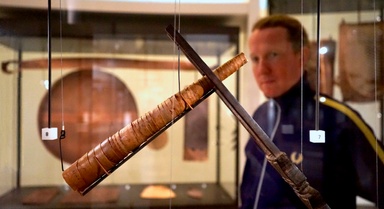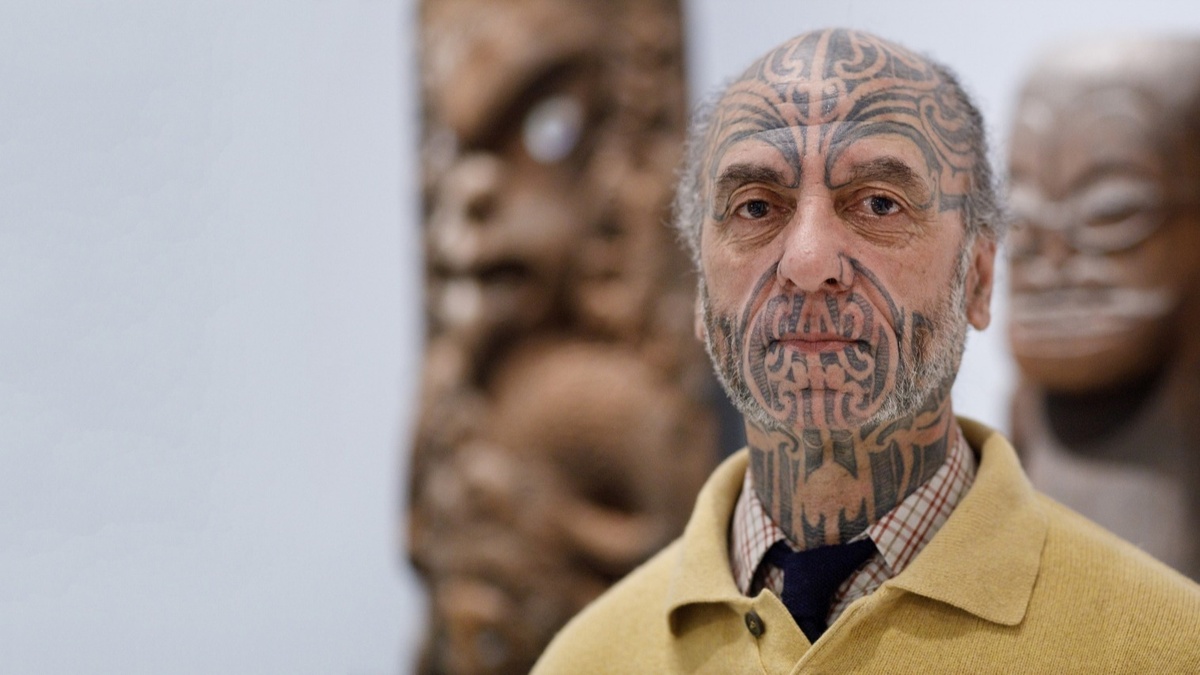
PHOTO: © George Nuku in der Ozeanien-Ausstellung des Ethnologischen Museums im Humboldt Forum © Staatliche Museen zu Berlin, Ethnologisches Museum / Pierre Adenis
Manatunga. Künstlerische Interventionen von George Nuku
In the organizer's words:
George Tamihana Nuku is one of New Zealand’s leading contemporary artists. As a sculptor, he works with stone, bone, wood, and shells, but primarily with Styrofoam and Plexiglas.
Starting May 18, 2025, the Ethnological Museum will present three large-scale installations by the Māori artist in two rooms of the “Oceania” exhibition area at the Humboldt Forum. These works were created during two fellowships that George Nuku completed in March 2024 and from March to May 2025 as part of the “Collaborative Museum” initiative.
George Nuku on the title of his exhibition:
“Manatunga is the Māori term for valuable objects, heirlooms, and ancestral treasures. The word implies that they stand—that they are upright. It is also used in the context that these special pieces are concentrated repositories of stories and emotions.”
Three installations in the Oceania section of the Ethnological Museum
The installations created by George Nuku specifically for the Oceania section of the Ethnological Museum’s permanent exhibition at the Humboldt Forum are on display in two rooms: A large-scale installation is located in the large boat hall (Room 215), focusing on the relationship between humans and the sea and the impacts of climate change and environmental pollution. Two additional installations are presented in Room 219, where artifacts from Polynesia and their connections to ancestors and deities are on display.
In all three installations, Nuku takes up the themes of the exhibition spaces and establishes a connection to the objects on display there from the Ethnological Museum’s Oceania collection. The contemporary artworks allow for a new perspective on the historical objects, as Nuku explains:
“To shed light on the present-day relationships between the past and the future, between new and old works of art, and between a descendant of the original families and the museum curators of these ancient treasures, which are now housed in the institution.”
Plexiglas waka
In the large boat hall, Nuku places a waka (New Zealand canoe) made of Plexiglas inside the large coral reef display case, steered by five men: the Māori demigod Maui and his four brothers. Maui uses a large fishhook to pull plastic sea creatures out of the ocean. George Nuku takes up the theme of the boat hall, illustrating the power of Te Moananui—the “great blue”—and the significance of the waka, through which people were first able to settle this ocean. The five men made of Plexiglas hold historical paddles or water scoops in their hands; the ends of the Plexiglas waka are adorned with historical stern carvings from the collections of the Ethnological Museum.
Gable of a Māori meeting house and ancestral figures
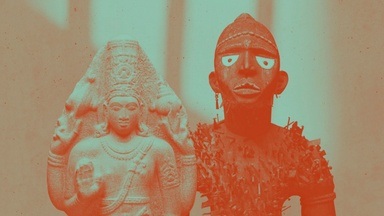
In Room 219, George Nuku presents two works: The gable of a Māori meeting house, made of Plexiglas, surrounds three ancestral and divine figures carved from wood and stone from Aotearoa/New Zealand, the Marquesas Islands, and Rapanui, and across from it, a Plexiglas gable structure shelters the wooden figure of the god Sope from Nukuoro.
The second artwork features four ancestral figures made of Plexiglas in the style of historical Māori carvings, surrounded by display cases designed specifically for them, which hold weapons and jewelry from the collections of the Ethnological Museum. The Manatunga (“Treasures of the Ancestors”) are presented standing up, rather than lying down as in the other display cases in the exhibition. They are shown as dynamic, living figures and confront visitors with their presence.
Plastic waste becomes living works of art
Nuku not only combines historical and modern materials such as wood and Plexiglas, as well as historical and modern works of art; he also establishes connections between the past, present, and future. Just as Māui once used his fishhook—carved from the jawbone of an ancestor—to pull Te Ika a Māui (Māui’s fish) and the North Island of Aotearoa/New Zealand out of the sea, he now brings plastic sea creatures to the surface.
These sea creatures also “live” in the “sea”—that is, in the display case beneath the waka: they are jellyfish, fish, rays, and corals made from PET bottles during a two-week workshop. In this way, the work addresses, among other things, the ecological challenges facing people in the Pacific and around the world. Plastic—whose production and disposal cause us major problems—is found in every part of the world and in all living creatures as a result of global environmental pollution. We view plastic as waste to be disposed of.
Nuku works with it and transforms it into vibrant works of art of high aesthetic value. He confronts viewers with a new dimension of the material and invites them to perceive it anew and to engage with “our trash”:
“Through my Māori heritage, I seek to reshape our relationship with the environment. For me, plastic bottles embody both light and water: the very source of life itself. To me, the plastic bottle is evidence of the divine. This leads me to the idea that pollution itself is sacred. It’s not too late to change our relationship with the environment and to engage with the plastic that influences every aspect of our lives today.”
Participants
George Tamihana Nuku (born 1964 in Omahu, Aotearoa/New Zealand) is one of New Zealand’s leading contemporary artists. As a sculptor, he works with stone, bone, wood, shells, Styrofoam, and Plexiglas. In his works, he repeatedly explores the relationships between humans, nature, and culture, using millennia-old traditional elements of Māori culture to contrast them with contemporary themes such as decolonization, repatriation, and reconciliation.
His works are exhibited internationally, for example at the British Museum (London), the Cambridge Museum of Archaeology & Anthropology, and the Musée du Quai Branly (Paris). His most recent major solo exhibition was presented in 2022 at the Weltmuseum Wien under the title “Oceans. Collections. Reflections.”
Partner
The exhibition project is part of the “Collaborative Museum” (CoMuse) initiative of the Ethnological Museum and the Museum of Asian Art. CoMuse aims to develop multi-perspective approaches to collection-based research and to test new formats for collaborative processes in order to sustainably advance the decolonization and diversification of museum practice.
- Price: An exhibition ticket for the Ethnological Collections and Asian Art is required. Regular price: 14 EUR; starting July 13, 2026: regular price 9 EUR
- Languages: German, English
- Location: 2nd floor, Oceania, access via the Ethnological Museum entrance
- Hours: Mon, Wed, Thu, Fri, Sat, Sun: 10:30 a.m.–6:30 p.m.; Tue: closed
Location
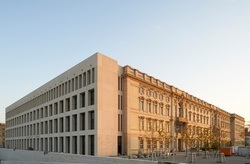
Accessibility information
We don't have any accessibility information for this event.
You can find everything about accessibility at Rausgegangen here.
Weitere Termine von Manatunga. Künstlerische Interventionen von George Nuku
06.
August
10:30
Berlin
Humboldt Forum
7,00 to 14,00 €
07.
August
10:30
Berlin
Humboldt Forum
7,00 to 14,00 €
08.
August
10:30
Berlin
Humboldt Forum
7,00 to 14,00 €
You might enjoy this as well?



Noch mehr Events dieser Location-Page