Many Shades of Grès. Mode wird Kunst
In the organizer's words:
Sensational fashion by one of the most important pioneers of haute couture in the 20th century as well as outfits inspired by student designs - the Kunstgewerbemuseum (KGM) is presenting the fascinating work of French fashion designer Madame Grès (1903-1993) for the first time in German-speaking countries.
The focus is on the KGM's Grès collection of 25 models, one of the largest outside Paris, where Grès worked throughout her life. In collaboration with the "School of Culture and Design" of the Berlin University of Applied Sciences, the exhibition illuminates the cosmos of the extraordinary couturière from different perspectives.
Around 150 different exhibits are shown in nine sections, which can be read as cross-references to the 25 models by Madame Grès, who are literally at the center of the exhibition. Among other things, the exhibition will feature clothing on busts and figurines, accessories, graphics, drawings, photographs, sculptures, textile objects and multi-media installations (films, projections). They are complemented by student positions and contextualizing works - including sculptures, paintings, photographs, graphics, films and virtual elements.
Who was Madame Grès?
Germaine Émilie Krebs began her career in the 1930s when she founded the fashion house "Alix Barton" together with Julie Barton - now as Mademoiselle Alix. One of the most important objects in the collection of the Museum of Decorative Arts dates from this time: a glittering evening blouse made of a net fabric with faceted gemstones. After 1937, she called herself Alix Grès and eventually went down in fashion history as "Madame Grès".
Grès' handling of fabric is incomparable: several meters are gathered, folded and draped to just a few centimetres, creating an impressive volume. Madame Grès, of whom only a few statements have survived, once told the press that she designed on the model, not on the table, and that her scissors were her most important instrument. The sophistication with which she develops an essentially simple cut into a highly complex sculpture on the body is therefore particularly fascinating.
Classical antiquity and timeless elegance
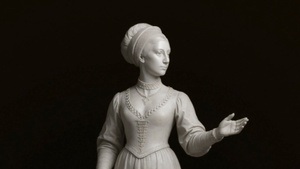
She became famous for her floor-length, pleated dresses, for which Grès, who - it is said - actually wanted to become a sculptor, was inspired by ancient sculptures. The great relevance of Madame Grès, who designed dresses for Grace Kelly, Greta Garbo and Marlene Dietrich, among others, which continues to this day, is revealed in the timeless elegance of these models based on classical antiquity. In direct juxtaposition with exhibits from the Collection of Classical Antiquities, the Museum of Byzantine Art and the Picture Gallery, this important aspect is taken into account in the exhibition.
A special exhibition of the Kunstgewerbemuseum - Staatliche Museen zu Berlin with the "School of Culture and Design" of the Berlin University of Applied Sciences
This content has been machine translated.Price information:
Admission: €12.00, reduced €6.00; free admission for children and young people up to and including the age of 18.
Location











Events near you
Activities near you
Popular event locations
The best event recommendations for the Rausgegangen App!
