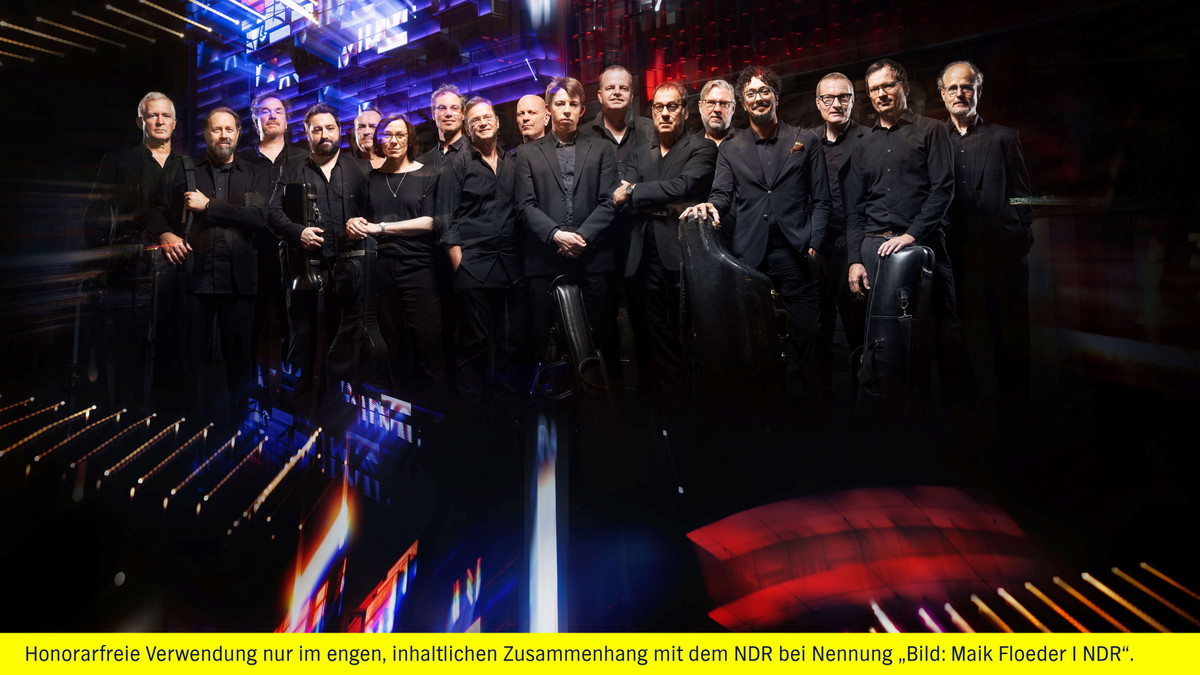
PHOTO: © Maik Floeder / NDR
NDR Bigband - Django Bates - Ode to Joy
In the organizer's words:
Subscription #2
Django Bates - Ode to Joy
Django Bates (p, comp)
Nikki Iles (cond)
NDR Bigband
"Our piano had a key that had shifted so that it played two notes. I stuck a pin in it so it would hit the right note. But every time you played that note - I think it was an F sharp - it rattled and there was a 'doioioioioing'! That had a certain effect on me."
A great musical career was founded on this childhood experience. Born in Kent in 1960, the multi-instrumentalist and composer Django Bates became an icon of musical pranks: pressing the buttons of different aesthetics, seeing what happens and then quickly running off to somewhere else. "There's a new mistake around every corner," says one of his songs, "just too good to miss."
Doing the wrong thing at the right time and doing the right thing with it - in the 1980s, this Monty Python of jazz rattled through the "loose tubes" of the 21-piece large formation Loose Tubes to great public acclaim. In 1991, Bates founded his own big band, the Delightful Precipices, followed shortly afterwards by the Powder Room Collapse Orchestra and Circus Umbilicus, a bright and colorful musical circus show. He also created large-scale compositions, including for the percussionist Evelyn Glennie and the Royal Liverpool Philharmonic Orchestra, wrote piano concertos and ballet music, and won the Danish Jaspar Prize, the Oscar of international jazz, in 1997.
Bates turns it dizzyingly on its head. He creates classical music from schmaltzy swing ("We're going to play a beautiful, beautiful, beautiful, beautiful, WONDERFUL old song in a terrible new way."), rhythms that knock themselves out ("why go to a concert if nothing happens?"), silences a virtuoso bebop saxophone with noise and wrestles down dreamy ballads with drunken hordes of dissonance.
For Ode to Joy, Bates has selected pieces from the album Spring Is Here (Shall We Dance?), released in 2008, as well as more recent works such as "Shorter Side Up", written in memory of the great man and musician Wayne Shorter, and a typical "Bates Beats the Beat" interpretation of the disco hit "Ain't No Stoppin' Us Now". In fact, the icon is no burden to the iconoclast, irony and sincerity chase each other up the stairs, neither catches up with the other. And that's why the program also includes "The Right To Smile", which leads into a "solemn interpretation" of Beethoven's An Die Freude / Ode To Joy.
"Even in dark times, my music must express optimism, a fundamental belief in humanity and better times. It will be a pleasure to meet the NDR Bigband for the first time and to play with a group of like-minded people, so there is indeed much to celebrate." - Henry Altmann
Location
You might enjoy this as well?









Noch mehr Events dieser Location-Page