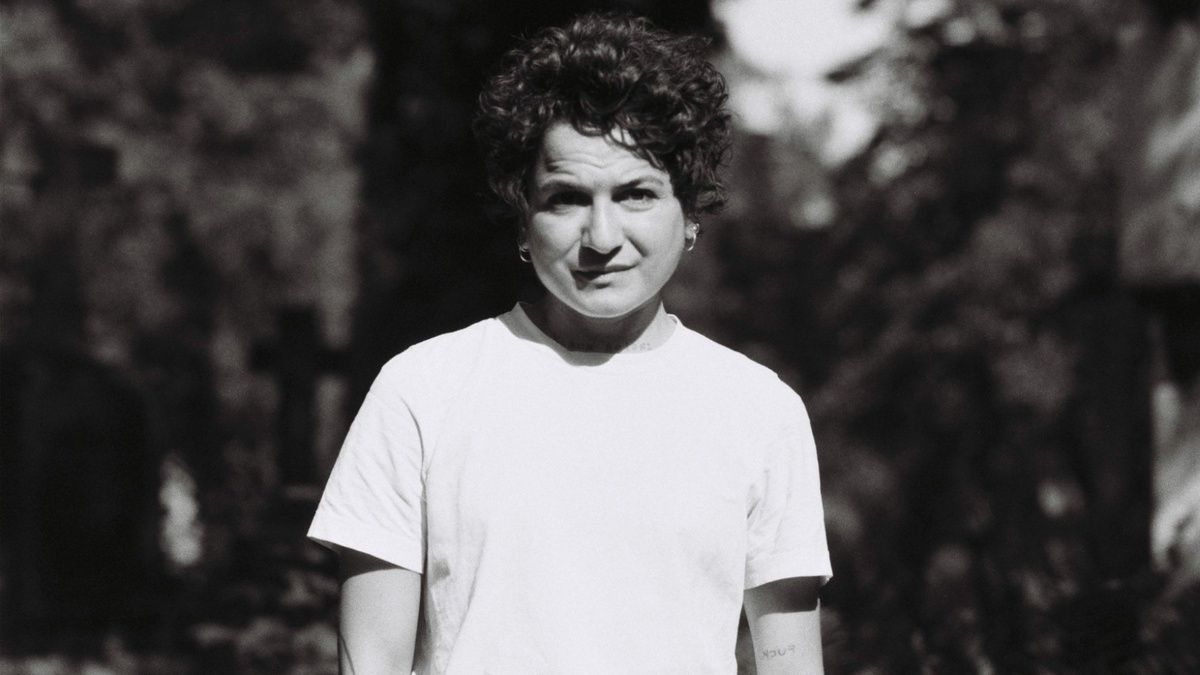
PHOTO: © Sebastian Kempff
Sinem "Hatun Release Tour"
In the organizer's words:
Hatun always knew what she wanted. Hatun packed her suitcase and left for Germany. Her husband stayed behind; he and the children joined her later. By then, Hatun had long since found work in a village in Upper Bavaria and, through her intelligence, hard work, and prudence, had made herself indispensable. Today, Hatun is old, and she’s becoming forgetful. But there’s one thing she understood well, and she won’t forget it: Sinem makes music; she sings and dances on stage. Sinem has now recorded her second album, and it will bear her name: “Hatun.” A picture of her—the young Hatun—will also be featured on the album. Sinem is her granddaughter, and she knows exactly what she wants.
Sinem grew up in Upper Bavaria, on Lake Ammersee. She moved to Munich, where she still lives today. Her father used to play her Western pop music—the cool kind: “Tanz den Mussolini.” At her grandparents’ house, they played and sang music from their homeland. The classics of Turkish pop culture, which are reinterpreted again and again, often by female singers whose names have eventually taken on a mythical quality because they are not simply singers. They interpret the lyrics of the poet-singers, the aşiks, and they write their own. They speak of the things that matter: of love—unrequited, impossible, and lost—of pain and longing. But also of what is happening in the village, in the country, and in the world; of injustice and of resistance against it.
On her first album, “Köşk,” Sinem covered such classics. What they all had in common was that they conveyed a stance. Through their lyrics, their sound, or through elegant moves like this one: singing the song of a macho man who talks about a woman. But the fact that it’s now Sinem’s voice singing these words—and that she’s ecstatically writhing on stage as she does so—says more than any feminist seminar ever could. That’s Anadolu Punk.
The new album, “Hatun,” begins with “Ötme Bülbül Ötme,” written by Pir Sultan Abdal and performed by Sercan Öztürk and Hüseyin Korkankorkmaz. It’s one of the songs Sinem heard her grandparents sing. Perhaps it told them about life in a foreign land: “Don’t sing, nightingale, my garden is not joyful. I’m wasting away with longing for you.” For “Hatun,” Sinem has once again taken on classics by Sezen Aksu, Erkin Koray, and others that hold special meaning for her and have been with her for a long time.
Sinem, the band in which Tom Wu is responsible for the music and Sinem for the vocals, has now also written its own songs. Because they come from within themselves, they develop a power of their own. The voice of tradition is answered from the present; the past serves as an echo chamber for today’s stories.
The expectations others place on us only make us look back to the past and forward to the future, but never live in the moment and be content with what we do and who we are. Sinem has a defiant answer ready: “Bana ne”—I don’t care! “I did this myself. And I did that myself. What are you going to do about it? What's happening? I don't care!” On the album’s second track, Sinem raises her voice over a muscular, rocking track that stoically forges its own path with a steady stride.
“It’s not supposed to be like that,” they say. We’re supposed to play our assigned roles. But Sinem’s narrator in “Masal” no longer seems to buy into this fairy tale: A well-behaved, polite, quiet, sweet girl breaks out of her cage and transforms into a courageous, free-spirited, winged girl. Or is this beautiful story of her liberation just another fairy tale to which the girl is once again only allowed to nod obediently?
“Asla!” is a banger, not even two minutes long. It’s about a taboo that affects women more than men. You’re not supposed to stick your neck out too far. “Never!” so that the person you’re talking to doesn’t get the idea that you think you’re better than them just because you have certain talents. “I keep the most secret words. I don’t share them—I never share them. I sing the most beautiful songs. Don’t look at me—better not look at me.”
In “Agatha Christie,” the last of the songs on the album written by Sinem herself, a spotlight is shone on those men who, in the shadow of patriarchal norms, stare at women on the street—sometimes casually, sometimes quite brazenly, and thus turn them into objects to be judged and possessed. “Their faces are masked, shrouded in the darkness of the soul. They wait on every corner.” Agatha Christie often stayed at the Pera Hotel in Istanbul’s Beyoğlu district. Sinem also lived there for two years, walking every day under the gaze of the masked men. Now she looks back and casts off her veil: We see you, and when we see you, your gawking will come to an end.
Tom Wu has given each song its own unique touch, and various guitarists have recorded their riffs to accompany them. “Hatun” grooves along casually, reflecting Sinem’s self-confidence as she has begun to speak for herself—poetically and confidently. She now claims her place in her own words as well. Whoever tells it like it is calls the shots.
Hatun is proud of her granddaughter, and her granddaughter is proud of her.
Ulrich Gutmair
Location

Accessibility information
We don't have any accessibility information for this event.
You can find everything about accessibility at Rausgegangen here.
Organizer | Booking Agency

Weitere Termine von Sinem "Hatun Release Tour"
02.
November
20:00
Hamburg
Hafenklang
16,50 €
03.
November
20:00
Mainz
Kulturclub schon schön
16,50 €
13.
November
20:00
Karlsruhe
KOHI Kulturraum e.V.
16,50 €











Noch mehr Events dieser Location-Page