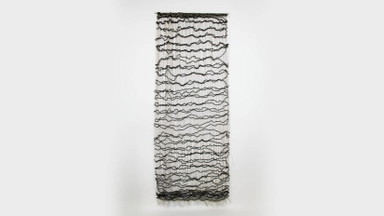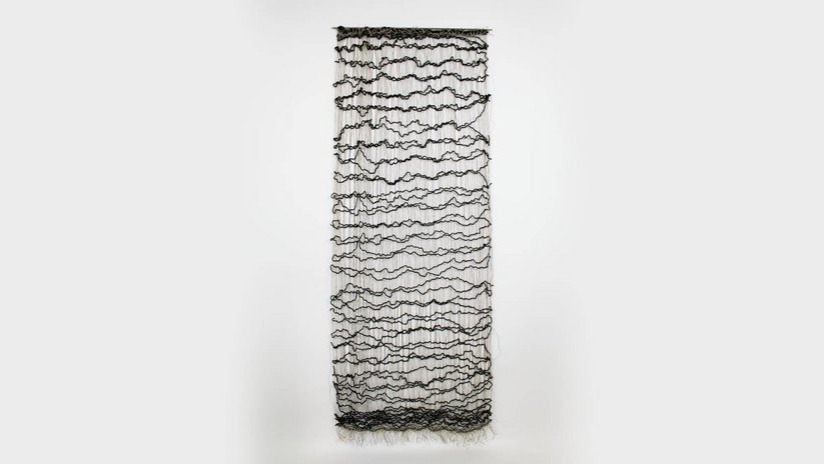
PHOTO: © Sofie Dawo, ohne Titel, 1963, Wolle, Kordel, Leinen, Wollschuss in Leinenkette, geknotet Foto: Jochum Rodgers, Berlin
Sofie Dawo. Textile Experimente
Berlin
In the organizer's words:
Sofie Dawo (1926–2010) was an exceptional artist: her unconventional artistic strategy consisted of enhancing the fabric through destruction. Through this radical treatment, the manufacturing process was virtually inscribed into the object itself, and the unpredictable—the “emerging surprises” (Dawo)—was deliberately factored in. Dawo’s textile experiments are free of any function or practical application and defy clear classification as either art or craft—they stand on their own.
The 22 works by Sofie Dawo, as well as selected works on paper presented at the Museum of Decorative Arts, are of particular interest due to their artistic value and represent a representative cross-section of Dawo’s oeuvre. But they also address core questions of the Museum of Decorative Arts: Where do the boundaries between art and craft lie? And who defines them, when, and for what reasons?
Consequently, Dawo made a point of being perceived as a textile artist, not as a craftsperson. Her experimental, artistic approach was characterized by her complete attunement to the material, its specific properties, and effects, allowing it to work under her hands—surprises and coincidences included. Dawo tapped into the material’s inherent potential in a variety of ways and, through her processing, sometimes pushed it to its physical limits—for example, by trimming threads, knotting them together, or enriching them with other materials such as metal, nylon, polyester, etc. She also heavily manipulated the textile surfaces by scoring them or deliberately damaging intact fabric. The avant-garde artist deliberately “broke all the rules,” thereby challenging traditional weaving techniques. Her works are not confined to a two-dimensional plane but often extend into space: they are textile sculptures.
The Textile Artist Sofie Dawo
Sofie Dawo is one of those textile artists who went largely unnoticed for a long time, even though she has made a significant contribution since the 1960s to liberating the art of weaving from the role of merely transforming a visual image into the textile medium. She eschewed the reproduction of a motif—whether figurative or abstract—or the depiction of a narrative in favor of work that was entirely free, arising purely from the material and its technical possibilities. In doing so, she helped weaving gain its rightful place as an autonomous art form.
Born in the Saarland, Sofie Dawo studied at the State School of Art and Crafts in Saarbrücken from 1948 to 1952, first in fine arts and then in weaving. She was a student of Boris Kleint, who had studied painting under Johannes Itten in Berlin and served as his assistant. In this capacity, Kleint had been appointed to Saarbrücken to introduce the Bauhaus-inspired foundational curriculum there, which likely had a profound influence on Dawo. After working as a designer, primarily on interior design projects for public spaces, Dawo returned in 1958 as head of the weaving and fabric printing department at the State School of Art and Crafts in Saarbrücken—now the Saarland University of Applied Sciences— and with which she remained closely associated until the end of her life.
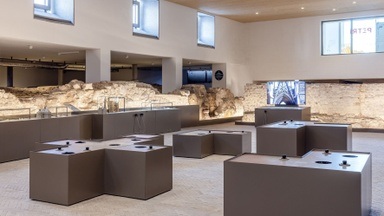
The exhibition is made possible by loans from Jochum Rodgers, Berlin.
A special exhibition ofthe Museum of Decorative Arts– State Museums of Berlin
Price information:
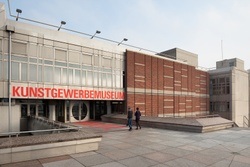
Admission to the Museum of Decorative Arts: €10.00, reduced rate €5.00; free admission for children and teens up to and including age 18.
Location
Weitere Termine von Sofie Dawo. Textile Experimente
17.
Juli
10:00
Berlin
Kunstgewerbemuseum
0,00 to 10,00 €
18.
Juli
11:00
Berlin
Kunstgewerbemuseum
0,00 to 10,00 €
19.
Juli
11:00
Berlin
Kunstgewerbemuseum
0,00 to 10,00 €