
In the organizer's words:
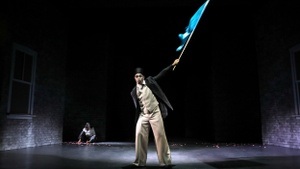
Winterreise is a poetic journey between music, thoughts and feelings: In her text, Elfriede Jelinek explores the themes of transience, foreignness and belonging - inspired by Franz Schubert's song cycle of the same name. "We are here because we are drawn away. By being drawn somewhere else, we are even there in a very special way," writes Jelinek, combining intimate self-reflection with social analysis. Without a fixed plot, the text unfolds in an intense, existential depth.
In the Dortmund production, the text becomes the occasion for a sensual and political search for clues. A joint search for new forms of expression, the translatability of language and feelings and common points of contact - somewhere between spoken language, sign language art, movement, music and visual means. Together with an ensemble of deaf¹ and hearing artists, the director explores the world of Winterreise , illuminating Jelinek's virtuoso language and its fragile landscapes in a completely unique and new way. While Schubert's song cycle Winterreise focuses on the despairing wanderings of a man through the wintry landscape, Jelinek's Winterreise becomes a score of loneliness.
¹ The adjective 'Taub' is used in capital letters. It is a self-designation of "people who feel connected to the sign languages, communities and cultures of the deaf."
This content has been machine translated.Location
You might enjoy this as well?






Events near you
Activities near you
Popular event locations
The best event recommendations for the Rausgegangen App!

Gemeinsam Events erleben
Events werden noch schöner wenn wir sie teilen! Deshalb kannst du dich jetzt mit Friends und anderen Usern vernetzen um Events gemeinsam zu besuchen. Loslegen