Kizomba Essência
In the page's words:
Kizomba Essência – Connected Through Dance
We organize Kizomba and Semba dance classes, practice sessions, and socials.
The Partner Dances Kizomba & Semba
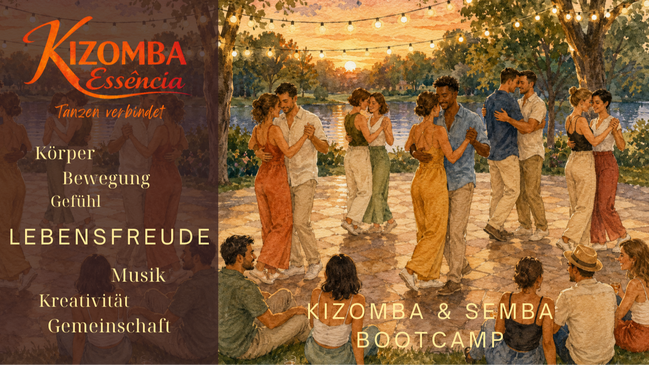
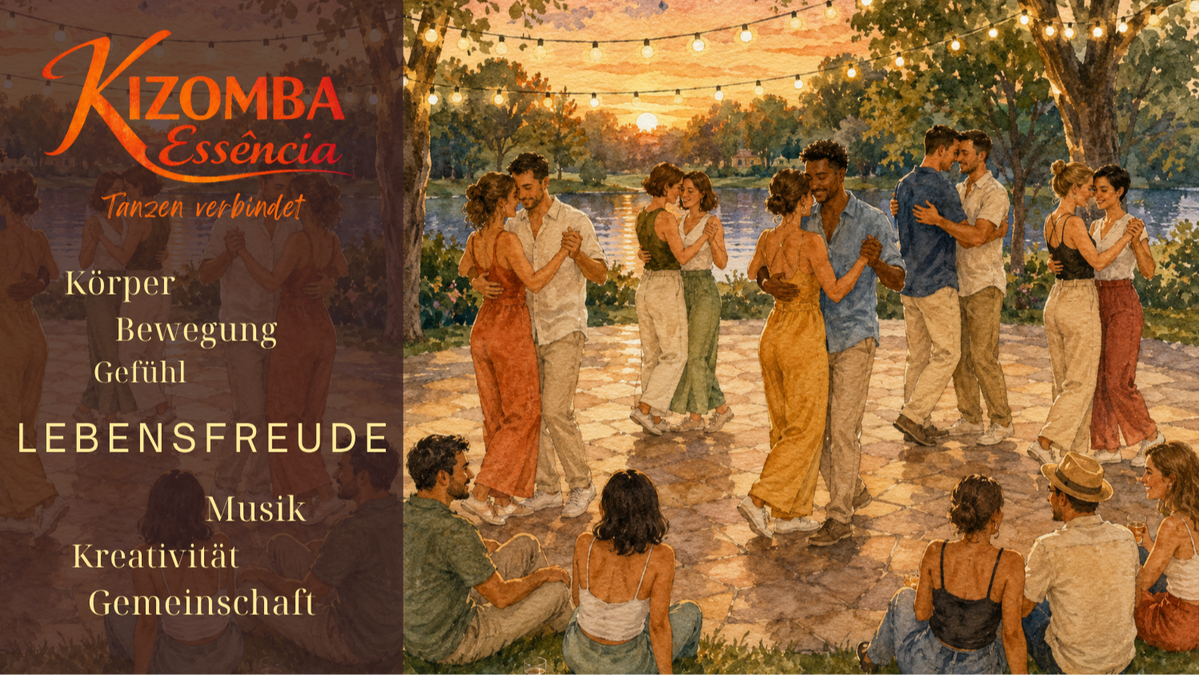
Kizomba is an improvised, sensual partner dance that originated in Angola. The name means “to enjoy oneself at a celebration.” Central to the dance are the connection between two people in an embrace and the interpretation of the music. From just a few basic elements, a wide variety of movements emerge without fixed step sequences. Similar to Argentine tango, but with a softer body awareness and an expression that incorporates the hips and upper body. The music is calm, rhythmic, and invites closeness and enjoyment. It ranges from classic kizomba to ghetto zouk to modern Afro beats.
Semba —the “mother” of Kizomba—is a partner dance with a high fun factor. The music is fast and inevitably evokes a feeling of summer and vacation. The dance encourages playful interaction, and you can have an incredible amount of fun together!
More info on Kizomba --> please scroll down and read Line’s text! :)
What Defines Kizomba Essência
We focus on the aspects that, in our view, define the “essence” of Kizomba—Portuguese for “Essência.”
Kizomba Essência stands for a way of dancing Kizomba that draws on its Angolan and Portuguese roots—close, musical, and collaborative.
The term “Kizomba” originally means “to enjoy oneself at a festival.”
And that’s exactly our vision: We want to create a place where people can meet, dance, laugh, and treat one another with respect. Community and trust are essential aspects.
Our focus isn’t on perfect technique, but on the way we dance together: with mutual respect, with attention to one another, and with a clear commitment to personal boundaries and individual needs.
For us, kizomba is a shared moment—a dance that’s less about appearances and more about how we connect with one another. We pay attention to body language and communication, and to ensuring that both partners feel good while dancing.
In our classes, we emphasize connection, mindful interaction, and relaxed learning.
More info on Kizomba --> please scroll down and read Line’s text! :)
Kizomba Essência Updates on Telegram (click to join!)
What is Kizomba?
A summary by Line
The word “Kizomba”
Kizomba is an improvised, sensual, and expressive partner dance that originated in Angola, Africa. The word comes from the Kimbundu language and roughly means “celebration, play, enjoyment.” It is the translation of the Creole word “Zouk,” which has the same meaning. The influence of Caribbean zouk music on the development of kizomba music is thus evident simply from the name.
Kizomba in Angola
In Angola, during the colonial era, Kizomba was danced to the music of the same name in the shady backyards of Luanda—in a convivial atmosphere among family, friends, and neighbors. Kizomba was a new way of dancing. Even today, kizomba remains an expression of the Angolan way of life and cultural identity. The hip movement while walking—banga for men and ginga for women—is neither a stylized gesture nor intended to be sexual. Rather, it is a natural, sensual way of moving.
Kizomba and Portugal
Modern, or European, kizomba emerged in Lisbon in the 1980s. The PALOPs brought their style of dancing to Portugal in the wake of the civil war. There, people began dancing Kizomba in nightclubs to Ghetto Zouk (a more beat-heavy style of music originating from the Cape Verde Islands). For the slow passages, the tarraxinha (“little twist”) was incorporated—and modern, or Portuguese, kizomba was born. The Angolan influence is still very strong in this style of kizomba. Kizomba is “dançar a passada,” or “walking dance.” It is characterized by flowing, circular movements and walking. The couple holds each other in a close embrace.
Modern Kizomba Fusion
Under the influence of other dances such as Urban Kiz, Tarraxo, Argentine Tango, Zouk, and hip-hop, another Kizomba dance style has emerged over the past decade: Kizomba Fusion. It has since become arguably the most common dance style at Kizomba parties in Europe. Typical elements include pivot turns, body waves, and straight, doubled movements. It is danced partly in a close embrace and partly in an open embrace.
Semba—the Mother of Kizomba
Semba is the mother of Kizomba and can be danced very well using the same technique but with a different style. The music is significantly faster
Other Dances Besides Kizomba
Urban Kiz and Tarraxo are distinct dances that have evolved under the influence of Kizomba and European-Western culture, but should be distinguished from it. Another dance and music genre that is now becoming increasingly popular at Kizomba parties in Europe is Konpa. Konpa has its origins in Haiti. The Caribbean dance style Zouk also emerged from Konpa music. However, it should not be confused with the more recent Brazilian Zouk.
The terms “Kizomba,” “Urban Kiz,” “Kizz,” or “Kiz”
Since the term “Kizomba” is used both generally to refer to all styles—or even to Urban Kiz—and exclusively to the Angolan or Portuguese style, confusion often arises. There is also no universally accepted definition for the term “Kizz” / “Kiz.” It is usually used as a synonym for “Kizomba.”
Here is a suggestion for clearly naming the different styles and dances:
Kizomba
- general term for all Kizomba styles, Kizomba Fusion, and Urban Kiz
- specific term for Angolan and Portuguese Kizomba styles (Tarraxinha)
Kizomba Fusion
- specific term for all Kizomba Fusion styles influenced by other dances such as Urban Kiz (“Kizz”), tango (“Kiztango”), Tarraxo, etc.
Kizz & Kiz
- Synonym for Kizomba (in general)
- Term for Kizomba Fusion influenced by Urban Kiz
Urban Kiz
- Another distinct dance style that, although it originated from Kizomba in France, should specifically be referred to not as Kizomba but as “Urban Kiz”
Kizomba Music
Kizomba and Kizomba Fusion are danced to different types of music. The best-known music genres are: Kizomba, Tarraxo, Ghetto Zouk, Douceur, Urban, and Kizomba remixes.
Kizomba and Semba are played with melodic vocals and live instruments as accompaniment. Ghetto Zouk, Tarraxinha, and Urban, on the other hand, are beat-heavy and electronic. What all these music styles have in common is the habanera rhythm. At parties, you’ll also often hear music like Konpa and Zouk, though these genres have their own distinct dances.
Sample videos
Kizomba (Style 1 Angola / classic):
Arnold Bunda & Sarah Amaro https://www.youtube.com/watch?v=Ju94kn4e9W4
Semba:
Arnold Bunda & Joelis https://www.youtube.com/watch?v=BGHr1C-WdLM
"Join Angola" https://www.youtube.com/watch?v=ZYJQd-el8LA
Kizomba (Style 2 Lisbon / Tarraxinha / modern):
Frans & Sarah Amaro https://www.youtube.com/watch?v=Io2ZVyZKg3I
Joao Rocha & Giedre Lapaite https://www.youtube.com/watch?v=mlBZj6gSEB4
Kizomba Fusion (Style 3):
Felicien & Isabelle https://www.youtube.com/watch?v=dm_TzKprOls
Albir Rojas & Olga Kryachko https://www.youtube.com/watch?v=FKHFemSNEpU
Leslie & Liliana https://www.youtube.com/watch?v=ZUAY1kE7lm0
More info about Kizomba:
Pedro Ferreira De Sa’s information page https://www.kizomba-classic.de/
Euronews documentary on Kizomba and Angolan identity https://www.youtube.com/watch?v=puj1rtdz79A