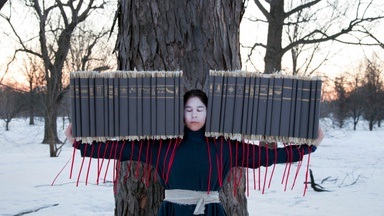
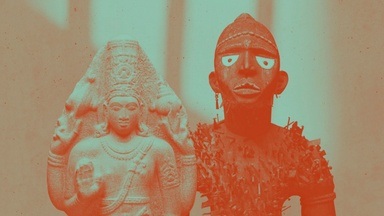
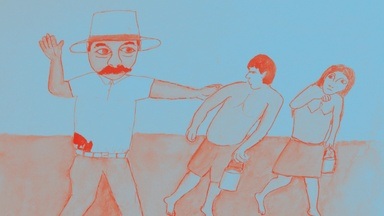
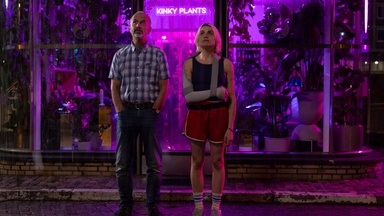
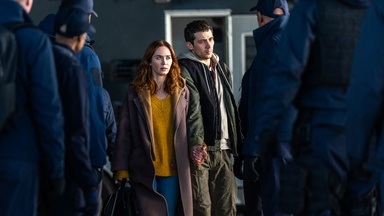
PHOTO: © Filmstill "So Close You Almost Can Touch It" (2025) des Künstlerduos Variable Name/Назва змінна © Variable Name
Flüssige Grenzen, bewegter Grund – Wo Wasser erinnert
In the organizer's words:
This artist talk explores how water, infrastructures and landscapes act as carriers of memory, loss and political violence. Using water as a methodological and perceptual framework, Valerie Karpan's artistic practice explores fluidity, transference and relationality as ways of experiencing and narrating space. Using film, sound and embodied forms of perception, the focus is on how environmental changes - such as flooding, dam construction or forced migration - are inscribed in bodies, narratives and everyday experiences.
The program includes a screening of the film So Close You Can Almost Touch It (2025) by the artist duo Variable Name/Назва змінна. The film addresses loss and adaptation in habitats shaped by hydrological interventions and war-related destruction, and creates speculative forms of collective memory and imagination. In dialog, the ongoing sound-based research project Hydraulic Border Intervals (2026) explores borders as dynamic zones shaped by rivers, radio waves and administrative regimes. The collective digital mapping project Kinography (2021) traces the history of modernist cinemas that emerged in the Soviet film distribution system and their local appropriations in Ukraine. As part of a broader practice of "counter-mapping", it focuses on physical experience, material engagement and collective processes.
The event opens up questions about how landscapes shape subjectivity and how artistic practices can develop new forms of perception, relationship and memory in fragile environments.
Participants
Valerie Karpan is an artist and researcher from Kyiv and a PhD candidate in Contemporary Art at the University of Coimbra. Her work operates at the intersection of participatory art, critical heritage research and decolonial perspectives on memory in Central and Eastern Europe. She investigates how infrastructures, landscapes and borders function as sites of memory, loss and political subjectivation. Valerie Karpan works with the Invisible University for Ukraine, is a co-founder of the NGO Cultural Geographies and a member of the artist collective Variable Name/Назва змінна (since 2018). She is currently a Research Fellow at the Käte Hamburger Center for Advanced Study in the Humanities inherit. heritage in transformation at the Humboldt-Universität zu Berlin.
Elisaveta Ernst is an art and visual historian specializing in the history and theory of photography. Her research deals with the epistemology and aesthetics of image-based knowledge production in art and science. Her other fields of work include the aesthetics of totalitarianism, the art history of Eastern Europe as well as gender/queer, postcolonial and post-secular theory and visual activism. She is currently research coordinator at the Käte Hamburger Center for Advanced Study in the Humanities inherit. heritage in transformation at the Humboldt-Universität zu Berlin. Previously, she was a research assistant at the Chair of Eastern European Art History at the Institute for Art and Visual History at the Humboldt-Universität zu Berlin.
- Language: English
- Humboldt Laboratory, 1st floor
- Belongs to: On Water
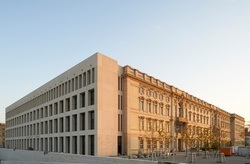
Location
You might enjoy this as well?




Noch mehr Events dieser Location-Page