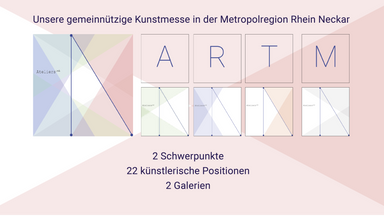
PHOTO: © Ateliers im Delta (AiD) Kunstbetrieb GmbH
Symposium - Art meets Science auf der AiD ART M
In the organizer's words:
Symposium at the AiD ART M 2026 in Mannheim
On June 14, 2026, the AiD ART M art fair in Mannheim invites you to a symposium on art as a cognitive practice, cybernetic thinking, cosmology and social orientation.
What role can art play in a present characterized by complex systems, scientific progress, technological upheaval and social uncertainty? The symposium "Art meets Science" on Sunday, June 14, 2026, as part of the art fair AiD ART M 2026, will address this question. The event will take place in room S4,17 Mannheim in Quadrat S4. Participation is free of charge, a ticket is required. ( https://aid-kb.org/tickets/ )
"Art meets Science" has been a central leitmotif of the Ateliers im Delta since 2010. This refers to an understanding of art that sees studios not only as places of production, but also as open spaces for exchange between artistic practice, science, technology and society. The symposium marks the start of a funded series of events in 2026 that aims to systematically deepen this dialog and facilitate new forms of transdisciplinary collaboration.
The focus is on a cybernetic approach: the world is understood as a structure of relationships, feedback and learning processes. Art does not appear as a mere illustration of scientific knowledge, but as an independent medium of perception, modeling and reflection. It can make visible how order is created, how systems change and how people orient themselves in complex realities.
A key concept of the symposium is "fifth-order architectures". They describe dynamic systems that do not function in a linear fashion, but develop further through experience, feedback, evaluation, transformation and design. For "Art meets Science", this model will be used both as an artistic tool and as a form of communication: It is intended to help make complex interrelationships accessible to people without a scientific background.
The symposium is divided into several thematic areas. It will begin with "The Architecture of the 10000 Things of Dao": an introduction to order, world views and the relationship between chaos and structure. This is followed by the thematic block "Cosmology & Order", in which creation myths, modern cosmology and artistic interpretations of the world are related to each other. The focus is on the question of how art can open up spaces of experience between knowledge, imagination and reality.
The section "Interdisciplinary Practice" is dedicated to the transitions between art, natural sciences, technology, cybernetics and research. This is not about the simple translation of scientific models into images, but about an artistic examination of open questions: indeterminacy, perception, self-organization, feedback and the role of the observer in the systems that he investigates.
Under the title "Art as a practice of cognition", the symposium explores how art develops its own methods of making reality visible, tangible and reflectable. Historical references range from the Renaissance to media art, scenography, photography and experimental forms of aesthetic research. Art is understood as a process that organizes perception, questions reality and opens up new relationships between experience, knowledge and imagination.
The final block, "Meta-art and the art of living", is dedicated to the artist and philosopher Adrian Piper. The focus is on the question of how art can contribute to self-observation, self-criticism and conscious life practice. Meta-art reflects not only on works of art, but also on the conditions of their creation, perception and evaluation. Life art extends this reflection to one's own thoughts, actions and decisions.
Artists and researchers at the interface of art and science are participating in the symposium, including Prof. Harald Fuchs, Prof. Dr. Gerhard Kilger, Dr. Paul Hirsch, Hannah S. Moser, Ralf Jochen Moser, Dieter Nusbaum, Dominik Schmitt and Rubica von Streng. The symposium is deliberately not only aimed at an art-related audience. It is aimed at people from science, technology, research, education, industry and urban society. Especially in Mannheim, a region with strong industrial, technological and scientific connections, "Art meets Science" sees itself as an invitation to experience art as an active form of thinking and as a contribution to participation, education and democratic culture.
The non-profit art fair AiD ART M 2026 is jointly organized by Galerie Ateliers im Delta (Mannheim) and Overhead Gallery (Münster). It combines contemporary art with exchange, promotion and social commitment. With "Art meets Science", it opens up a space for thought and experience in which art, science and life practice do not appear separate from each other, but as different approaches to a common question: How can people perceive more consciously, decide more freely and act more responsibly in a complex world?
Program on June 14, 2026:
11:00 a.m. - The Architecture of the 10000 Things of the DAO 11:20 a.m. - Cosmology & Order
13:00 - Lunch break
14:00 - Interdisciplinary practice
15:15 - Art as cognitive practice
16:30 - Meta-art and the art of living, dedicated to Adrian Piper
About AiD ART M 2026 - non-profit art fair in the Rhine-Neckar metropolitan region
Organizer: Ateliers im Delta, Mannheim, and Overhead Gallery, Münster Period: 7 June to 4 July 2026
Opening: Sunday, June 7, 2026, 2 pm; open from 1 pm
Location: Room S4,17 Mannheim in Quadrat S4, former city gallery, address: S4, 17
Opening hours: Friday and Saturday 3pm-8pm, Sunday 11am-6pm Admission: Free (ticket required)
Website: https://aid-kb.org/p-artm26
Website: https://aid-kb.org/p-art-meets-science/
Location

You might enjoy this as well?
Get the Rausgegangen App!
Be always up-to-date with the latest events in Mannheim!










Noch mehr Events dieser Location-Page