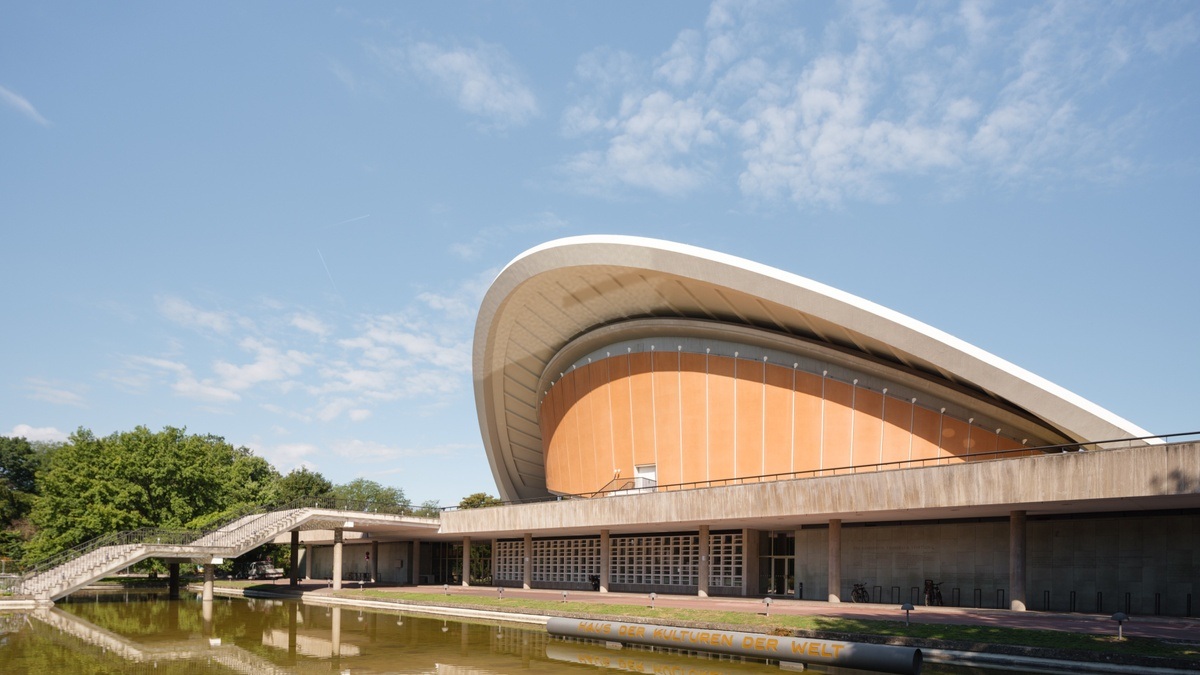
Als hätten wir die Sonne verscharrt im Meer der Geschichten

In the organizer's words:
As if we had buried the sun in the sea of stories - an exhibition and research project in equal measure - weaves an infinite fabric of narratives from artists, curators, writers and connoisseurs of traditional cultural practices. The project traces the many worlds that existed alongside and with each other, often despite or against the repressive ideas of the changing regimes - from the Russian Empire to the USSR to present-day Russia - that controlled large parts of Eastern Europe and Central and North Asia.
In view of this geographical reference, the project title seems a little eccentric. It is inspired by the poem "The Blesséd Word: A Prologue on Kashmir" by Kashmiri author Agha Shahid Ali, which he dedicated to his violence-stricken country in 1990. In it, Ali deals with the grief over the destruction of his homeland and relates his own fate to that of the poet Ossip Mandelstam, who was persecuted by Stalin's regime and forced into internal exile, eventually perishing in a camp. Ali's poem expresses the tragedy of his people and the longing for his lost homeland, quoting a line from Mandelstam - thus recalling another loss, at another time, in another place. Ali sings of his country, evoking its name in 18 different phonetic and graphic variations (including cauchemar, the French word for nightmare). As if we had buried the sun in the sea of stories is characterized by this rhythmization of times and places, the interweaving of verses from Ali and Mandelstam's poems and a polyphony of meanings, especially in times of Russia's renewed imperial belligerent aggression, which began with the invasion of Ukraine in 2014 and continues today in a brutal war of aggression.
Words are often a form of abuse. Whether the term "post-Soviet", which also defines the present with reference to a certain historical era, or the construct "Eurasia", as it is understood in contemporary Russia by the extreme political right (which has appropriated the state): Words impose certain meanings on places. The term "Northern Eurasia" in the subtitle of the exhibition is not intended as a future alternative designation. Rather, it is intended to be as neutral a geographical designation as possible - as neutral as geography somehow allows - a localization based on the absence of previous designations as well as that of the empire itself. In this gap, the diversity of repressed life, of communities that continue to exist against all odds, is more likely to suggest a future that is free and full of meaning.
Exhibitions never take place in a vacuum. This one follows the premises of its predecessor, O Quilombismo, which told of the power that arises from a multiplicity of epistemic traditions as a basis for new models of coexistence, free from the oppression that otherwise manifests itself at all levels of life and knowledge.
Poetry is a powerful tool because it shapes the imagination, which can itself create realities. How can another idea emerge of this vast part of the earth that has been lashed together by imperial conquest and subjected to the violence of naming along with countless other forms of brutality against individuals, communities and the environment? An idea that frees itself from the hegemon that united the individual territories into a single entity in the first place? An idea in which these territories no longer stand as a whole, but are dissolved into their constitutive parts, each of which deserves individual consideration? And how can an attitude of solidarity be consolidated between societies and communities that are at different stages of emancipation, while at the same time working their way out of the epistemic amalgam created by repressive power - which itself has been least influenced by processes of decolonization and opposes them with unspeakable violence?
As if we had buried the sun in the sea of histories presents a non-totalizing vision by invoking multiple forms of subjectivities, imaginaries and sensualities that colonization repressed and that later found no place in the canon of modernity; and by showing contemporary works that emphasize perseverance, resistance and joy, exploring a connectedness beyond constrained pasts. Many of the positions are shaped by this very canon, but are not subject to it. The exhibition and publication invite processes of collective memory, the revival of cosmologies and vanished knowledges, the contemplation of networks of those who defy imperial boundaries, the formation of collective resistance and, finally, a vision of futures that can be lived, survived and enjoyed.
This project was conceived in collaboration with curator Iaroslav Volovod, who researches the colonial history of the Russian Empire and the USSR; artists and curators Nikolay Karabinovych and Saodat Ismailova; and historian Kimberly St. Julian-Varnon, whose research focuses on the former Soviet sphere of influence.
Price information:
Free admission on Mondays and every first Sunday of the month (Museum Sunday Berlin)
Location
You might enjoy this as well?







Events near you
Activities near you
Popular event locations
The best event recommendations for the Rausgegangen App!

Gemeinsam Events erleben
Events werden noch schöner wenn wir sie teilen! Deshalb kannst du dich jetzt mit Friends und anderen Usern vernetzen um Events gemeinsam zu besuchen. Loslegen