Ein Ferngespräch. Szenen aus der Weimarer Republik

In the organizer's words:
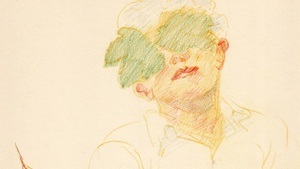
The artist Käte Hoch shows her friend Erich Müller-Kamp on the phone at his desk. Kurt Tucholsky advises that a long-distance conversation should be conducted as clearly and without dialect as possible, otherwise the surveillance officers will not be able to follow the dialog. Hoch paints himself in the colors of the suffragettes and with a bob. Young employees also cut their hair short. They type fast, chain smoke and go to the movies or dance clubs in the evening. They love the Charleston and shimmy, listen to raunch, swing and jazz.
Irmgard Keun's "Kunstseidenes Mädchen" dreams of slender silhouettes and shoes with lizard caps. Ré Soupault develops a transformation dress that can be changed in the office for the evening. In the Variété, gender roles become permeable, monocles send signals. Brothels form an established framework for sex work.
The economy flourishes, often on credit, parts of the population become impoverished, not only during hyperinflation and the Great Depression. War invalids, workers, the unemployed and violet sellers characterize the streets and counteract the Golden Twenties. Oskar Maria Graf distributes anti-fascist leaflets with a working group, feminists and the Munich Anti-War Committee meet in Schwabing and a local group of the revolutionary artists' association ASSO is working on a magazine. George Grosz depicts the rise of the National Socialists and caricatures the Hitler salute.
The new theater of Helene Weigel and Bertolt Brecht longs for the power of boxing and tries its hand at dialogues that sit like chin hooks. In 1923, the first state-controlled radio program is broadcast in Germany - Max Radler paints a factory worker listening to the radio. In 1930, Tim Gidal takes a photo of one of the first television broadcasts at the Deutsches Museum.
The exhibition concentrates on concrete stories and tangible details rather than formulating grand theses on the Weimar period. The aim is to establish contact with the buried possibilities of the Weimar Republic - a long-distance conversation.
With works by Käte Hoch, Heinrich Hoerle, Karl Hubbuch, Lotte Jacobi, Grethe Jürgens, Jeanne Mammen, Gabriele Münter, Christian Schad, August Sander, Rudolf Schlichter and others.
In cooperation with the Münchner Stadtmuseum and with the generous support of a private collection.
Curated by Karin Althaus and Matthias Mühling.
This content has been machine translated.Price information:
Regular: 10,00€ / Reduced: 6,00€
Location
You might enjoy this as well?




Events near you
Activities near you
Popular event locations
The best event recommendations for the Rausgegangen App!

Gemeinsam Events erleben
Events werden noch schöner wenn wir sie teilen! Deshalb kannst du dich jetzt mit Friends und anderen Usern vernetzen um Events gemeinsam zu besuchen. Loslegen