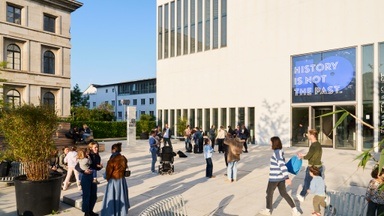
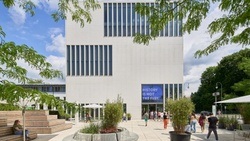
PHOTO: © NS-Dokumentationszentrum München | Ansicht 2025 | Foto: Connolly Weber
Gegenwehr im Jetzt | Asal Dardan, Lena Gorelik, Dietmar Süß und Shelly Kupferberg
PICK OF THE DAY
You cannot miss this event.
So, 07. Jun 2026
11:00 - 12:30
München

In the organizer's words:
Why remembrance must become action: Germans describe themselves as 'world champions of remembrance' - and yet the AfD is celebrating historic electoral successes. In a conversation with Shelly Kupferberg and in three essays, the renowned authors Asal Dardan, Lena Gorelik and the historian Dietmar Süß examine whether anything can be learned from the past, why memory is hierarchical, who it excludes, when it only serves to exonerate or as an immunization strategy, how critical, solidary and democratic memory actually is and why it can be so easily instrumentalized. And they come to the conclusion: We must understand remembrance as daily, self-critical action, and as responsibility. Instead of 'never again' as an empty formula, we need 'resistance in the now'.
About our guests
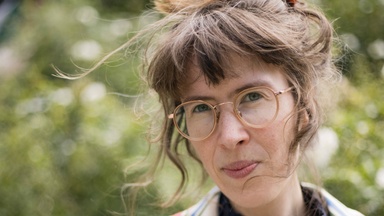
Asal Dardan, born in Tehran in 1978, grew up in Cologne, Bonn and Aberdeen. She studied Cultural Studies in Hildesheim and Middle Eastern Studies in Lund and now lives in Berlin. She was awarded the Caroline Schlegel Prize for Essay Writing for her text New Years . Her essay collection Betrachtungen einer Barbarin (2021) was nominated for the German Non-Fiction Prize and the Clemens Brentano Prize. In May 2023, she gave the first Erika Mann Lecture at the Ludwig Maximilian University of Munich. Her most recent publication is Traumland: Eine Spurensuche in deutscher Vergangenheit und Gegenwart (2025).
Lena Gorelik, born in St. Petersburg in 1981, came to Germany with her parents in 1992. Her novel Hochzeit in Jerusalem (2007) was nominated for the German Book Prize, while her highly acclaimed Mehr Schwarz als Lila (2017) was nominated for the German Youth Book Prize. Lena Gorelik regularly writes articles on social issues, including for the Süddeutsche Zeitung and Die Zeit. In 2024 she was awarded the Heinrich Mann Prize for Essay Writing and in 2026 the Prize of the Houses of Literature. In the same year, Alle meine Mütter, a new novel, was published. She lives in Munich.
Dietmar Süß, born in Neuss in 1973, is Professor of Modern and Contemporary History at the University of Augsburg. His award-winning research focuses on the history of social movements, the history of labor and National Socialism. His publications include: Death from the Air. Luftkrieg und Kriegsgesellschaft in Deutschland und England (2011) Ein Volk, ein Reich, ein Führer. German Society in the Third Reich (2017), Der seltsame Sieg. The comeback of the SPD and what it means for Germany (2022).
Shelly Kupferberg, born in Tel Aviv in 1974, grew up in West Berlin and studied journalism, theater and musicology. She is a journalist and presents programs on culture and society for Deutschlandfunk Kultur and RBB radio3. Her first book, Isidor , was a success with the public and the press. Shelly Kupferberg lives with her family in Berlin.
Participation free of charge. No registration necessary.
Price information:
No registration necessary.
Location
You might enjoy this as well?









Noch mehr Events dieser Location-Page