Layers of Perception - Duo Show mit Árpád Forgó & Hanna Kaminski

In the organizer's words:
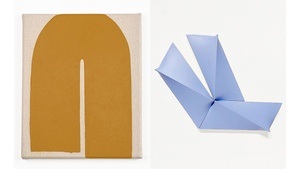
Árpád Forgó (*1972), visual artist, lives and works in Budapest, is a representative of the traditional "Shaped Canvas" movement in the Hungarian contemporary art scene. He explores modularity and perception, which he sees as exciting areas to expand the boundaries of a mural. He continues to develop shaped canvas panels and build block-like, hollow, symmetrical or asymmetrical modular compositions through isometric transformations. He also experiments intensively with various composite painting processes in order to challenge the viewer's perception not only through the structure but also through the material.
In the works of Hanna Kaminski (*1988 in San Francisco, lives and works in Berlin), the picture support resembles a landscape of iridescent color applications in which the forms are created by overlapping layers of paint. The paintings present an open, surreal and cartoonesque visual language. Always on the edge of the recognizable, the already seen, the forms elude any overly quick interpretation. For Hanna Kaminski, the medium of painting is a means of dissolving initial, motivic ideas and developing her own formal language. Random moments in the working process require her active, conscious reaction and keep the creation of her paintings in constant, productive tension. It is not only the motif that tells the story, but also the medium itself. Traces of overpainted layers speak of time and the process of her work.
This content has been machine translated.Location
You might enjoy this as well?






Events near you
Activities near you
Popular event locations
The best event recommendations for the Rausgegangen App!
