PHOTO: © SFB 1601
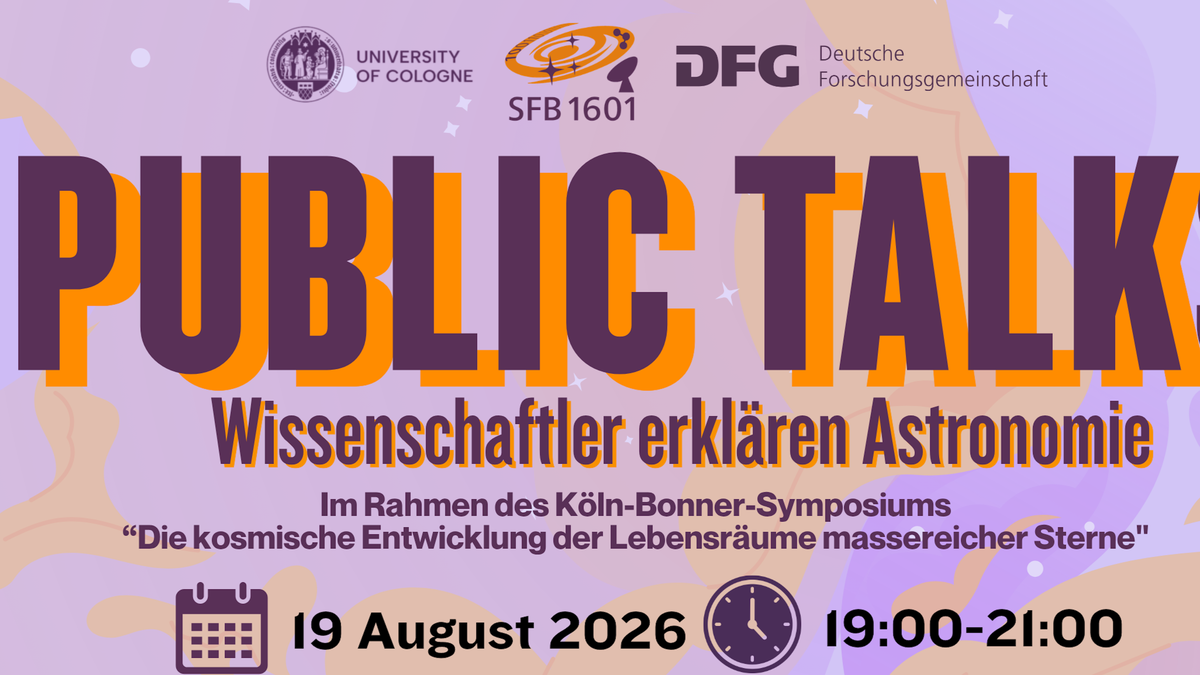
SFB1601 Public talk: Die kosmische Entwicklung der Lebensräume massereicher Sterne
Mi, 19. Aug 2026
19:00 - 21:00
In the organizer's words:
We cordially invite you to a public lecture as part of our conference. Three researchers from SFB 1601 will contribute to the conference with an accessible and entertaining lecture on astronomy in both German and English!
https://sfb1601.astro.uni-koeln.de/19-08-2026-public-talk-about-habitats-of-massive-stars-across-cosmic-time-aula-uoc/
Eline Plaar:
“Spectral Fingerprints: How Laboratory Work Decodes the Universe”
How do we determine the chemical composition of distant stars, clouds, or exoplanet atmospheres? The key lies in molecular spectroscopy: Every molecule absorbs and emits light in a characteristic way, leaving behind a unique spectral fingerprint. This lecture explains how these fingerprints are formed and how astronomers use them to chemically map the universe—because without precise laboratory data, even the highest-resolution spectra from modern telescopes like the James Webb Space Telescope remain silent. With a special focus on charged molecules studied using ion traps, it becomes clear how laboratory spectroscopy and astronomical observation go hand in hand.
Simon Dannhauer:
Astronomy at High Altitudes
Whether it’s the flying observatory SOFIA or the new FYST at an altitude of 5,600 meters in Chile. Astronomers are captivated by high altitudes and are building telescopes for increasingly extreme locations. But why, exactly? The answer is literally hidden among the stars: in cold gas and dust that is only visible in far-infrared light—light that our atmosphere absorbs. Drawing on current research into star formation in our Milky Way, this lecture explores why some questions can only be answered with extreme instruments in extreme locations—and that while the altitude may sometimes take your breath away, the insights never do.
Tim-Eric Rathjen:
The Universe Inside a Computer
What does it take to create planets, stars, galaxies, and indeed the entire Universe inside a supercomputer? What does a theoretical astrophysicist actually do, and why do we need such powerful computing machines for this work? This talk offers fascinating insights into the world of numerical astrophysics and showcases impressive images and videos from a “universe inside a computer.”
Location

Accessibility information
We don't have any accessibility information for this event.
You can find everything about accessibility at Rausgegangen here.









![[ku:]mmunity](https://imageflow.rausgegangen.de/url/https%3A//s3.eu-central-1.amazonaws.com/rausgegangen/Nii123ITmWRgMwdYMWRp_miteinanderneumarktcontainer16-9.jpg?width=384&height=216&mode=crop)