TRIO ESTATICO - Viola Consort | PALINGENESIS

In the organizer's words:
--------------------------------
TRIO ESTATICO | Viola-Consort
"PALINGENESIS"
SA 08.06.2024, 8 pm (admission from 7:30 pm)
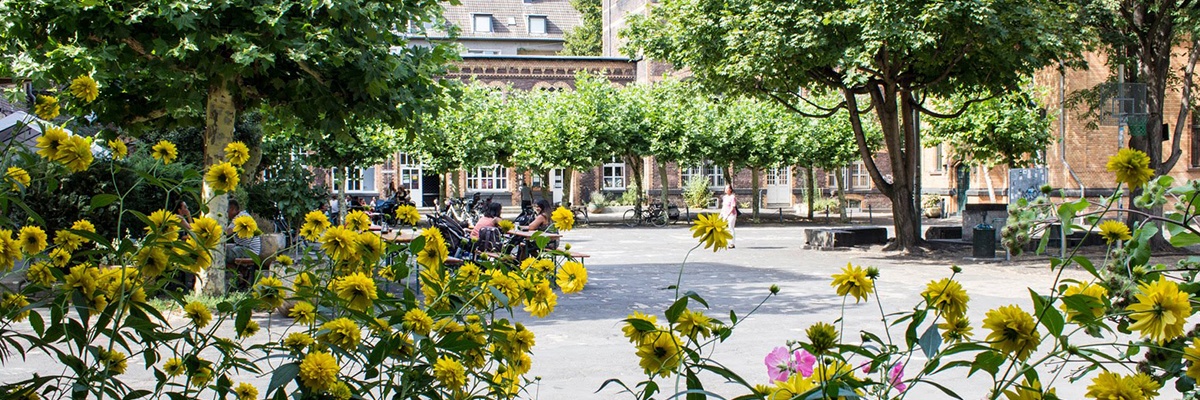
Stage - Alte Feuerwache Cologne
Free admission
--------------------------------
TRIO ESTATICO is an international viola consort that brings together musicians from three of the most renowned new music ensembles in Europe to develop a new repertoire and new ways of making music. The ensemble was founded in 2019 and consists of violists Paul Beckett (England, Ensemble Klangforum Wien), Megumi Kasakawa (Japan, Ensemble Modern Frankfurt) and John Stulz (USA / Ensemble Intercontemporain Paris)
--------------------------------
Program
Malika Kishino (Japan)
Butterfly Dance II (2024) World premiere
Commissioned by Trio Estatico
Francisco C. Goldschmidt (Chile)
Palingenesis (2023/24) world premiere
for amplified viola trio, electronics & sound installation
Commissioned by the city of Cologne
Concert duration: 60 min.
--------------------------------
TRIO ESTATICO
Paul Beckett
Megumi Kasakawa
Laura Hovestadt (guest)
Pablo Garretón, sound direction
Paul Pape, sound installation
Francisco C. Goldschmidt,
Artistic direction and electronics
Supported by Musikfonds, IFM e.V. Köln and the Cultural Office of the City of Cologne.
--------------------------------
About the concert
The project "Palingenesis" consists of the world premiere of an interdisciplinary work conceived and composed for amplified viola trio, electronics, light direction & sound installation by the Chilean composer Francisco C. Goldschmidt .
The theme of the work is "Palingenesis" (Greek for rebirth / new birth) and shows different interpretations of the term. For Nietzsche, the term "palingenesis" refers to the eternal return of the same and for Heraclitus to the new creation following the cataclysmic disasters after the end of a world cycle. In geology, it refers to the re-melting of rock into magma.
The sound installation is designed by visual artist Paul Pape . Three expansive steel skeletons stand on the stage, forming a sound shadow opposite the Trio Estatico. They remain in the room in long curved forms or angular, taut shapes. Standing on joints, they can set themselves in motion together with the musicians. The resulting friction creates sounds that the composer collects and feeds back into the space. The play of swinging sculptures or still hanging sound bodies can begin with the Trio Estatico.
In addition, the new work "Butterfly Dance II" for viola trio by the renowned Japanese composer Malika Kishino will also be premiered in the concert evening. In Japan, the butterfly, called 胡蝶 (kocho), is a symbol of life force or soul. Butterfly dance (Kocho no Mai) is the name of a dance music of the old Japanese court music, Gagaku. The name "butterfly" comes from the fact that it is a four-person dance depicting four butterflies dancing on a spring day. "In my piece Butterfly Dance, I treat each string player like a butterfly. For me, the circular movement with which the silkworms turn is like a metaphor for chains of life. The music evolves gradually and constantly, as if it were our life cycle.
--------------------------------
About the composers
Francisco C. Goldschmidt
Born in Santiago de Chile in 1981, he studied composition with Cirilo Vila and Aliocha Solovera at the University of Chile. He later completed a master's degree in theory and art history at the same university under the guidance of the philosopher Sergio Rojas. He has lived in Germany since 2011, where he completed a master's degree and concert exam in instrumental composition at the Cologne University of Music and Dance under Johannes Schöllhorn.
His work shows a particular fascination for solo and chamber music in a reduced format. The internal polyphony of the individual voices, the use of resonances and the intensive interweaving of secret songs are characteristic of his work. Sudden changes of temperament and tempo lead to divergent and ambivalent music that is always characterized by fragility. The question of permanent bifurcation, lack of identity, isolation, disorientation and the labyrinth are themes that run through his work. On the other hand, working with amplification and spatialization of sound as well as the interdisciplinary collaboration with the video artist Nicolás Rupcich (*1981) are an essential part of his artistic project.
His compositions have also been performed by ensembles such as the mdi ensemble (Italy), the Spóldzielnia Muzyczna (Poland), the Ensemble Lucilin (Luxembourg), the TimeArt Studio (Taiwan), the Ensemble Exophonie Tokyo (Japan), the Colectivo Azul, the Ensamble Contemporáneo UC (Chile), the Fukio Saxophone Quartet, the Neues Ensemble Hannover, the Kommas Ensemble, MAM.manufaktur für aktuelle musik, hand werk, Cologne Guitar Quartet, IEMA, Studio-MusikFabrik, Ensemble KNM Berlin, Ensemble Recherche (all Germany), as well as the Vertixe Sonora Ensemble (Spain) and Friends of Mata (USA). His music has also been performed at various festivals, including the UC-Festival in Santiago de Chile, Concerts-Lab in Tokyo, Ciclo-Cervantes in Buenos Aires, MATA-Festival in New York, Ensems in Valencia, WERFT and Acht Brücken in Cologne.
His work has been recognized with numerous awards, including: Finalist at the Luis Advis Orchestra Competition 2007 in Chile; Prize at the NRW Landesmusikrat-Gürzenich Orchestra Competition 2011; Chilean CNCA Scholarship 2012/13 and 2015/16; RheinSilver-Award-2014 of the New Talents Biennale in Cologne; Second Prize at the Felix-Mendelssohn-Bartholdy-Hochschulwettbewerb 2014 in Berlin; Participation in the SWR Orchestra Workshop 2012 and 2016 of the SWR Symphony Orchestra Stuttgart; Bernd Alois Zimmermann Scholarship 2016 of the City of Cologne; Scholarship holder residency Schöppingen 2019; Funding of four composition commissions by the Ernst von Siemens Music Foundation (2018/2019/2020/2023); "Forum-junger-Komponisten 2020" prize of the Bavarian Academy of Fine Arts Munich.
Francisco C. Goldschmidt has lived and worked as a composer in Cologne since 2011 and is Artistic Director of the Kommas Ensemble.
--------------------------------
Malika Kishino
was born in Kyoto/Japan in 1971. Studied law in Kyoto (graduated in 1994). From 1995 studied composition with Yoshihisa Taira at the L'Ecole Normale de Musique de Paris (Diplôma supérieur 1998). 1999-2003 studied with Robert Pascale at the Conservatoire National Supérieur de Musique et Danse de Lyon (Diplôme national d'études supérieures Musicales 2003). One-year course in computer music at IRCAM Paris (2004-05). Prizewinner at the 70th Japan Music Concurs, 1. Prize of the Concours de Groupe de recherche appliquée en musique électroacoustique (GRAME) and the Ensemble Orchestral Contemporaine in Lyon, 69th Otaka Prize of the NHK Symphony Orchestra Tokyo, Rome Prize (Villa Massimo), nominated for the Composition Prize of the Prince Pierr Foundation in Monaco, Fellowship of the Experimental Studio Freiburg, Fellow at the Center for Art and Media Technology, Institute for Music and Acoustics (ZKM, Karlsruhe), Centre Henri Pousseur Liége, Fellow at the Akademie Schloss Solitude. Scholarship holder of the state government of North Rhine-Westphalia, Lower Saxony artist scholarship for the Künstlerhof Schreyahn.
Composition commissions and performances (selection):
Radio France, le ministère de la Culture et de la Communication, Westdeutscher Rundfunk, Bayerischer Rundfunk, RBB- Rundfunk Berlin Brandenburg, Wittener Tage für Neue Kammermusik, Donaueschingermusiktage, Südwestdeutscher Rundfunk, Acht Brücken Festival, Essen Now ! Bregenz Festival, Warsaw Autumn, Beethovenfest, Biennale di Venezia musica, Davos Festival, Musica Strasbourg, Festival Ultima Oslo, Arsmusica Brussels, Suntory Summer Festival (Tokyo) etc.
--------------------------------
Location













Events near you
Activities near you
Popular event locations
The best event recommendations for the Rausgegangen App!
