


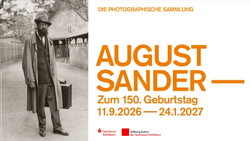
PHOTO: © Marie Laforge, Die Photographische Sammlung/Stiftung Kultur
Ausstellungseröffnung - August Sander | Zum 150. Geburtstag

In the organizer's words:
August Sander – Marking the 150th Anniversary of His Birth
September 11, 2026 – January 24, 2027
Exhibition opening on September 10 at 7 p.m. Free admission; no admission ticket is required.
As part of the opening, the 2026 August Sander Prize will be awarded to Frieder Bickhardt (*1987) for his project “City Plaza.”
The 150th birthday of August Sander (1876–1964) provides us with a welcome opportunity to pay a comprehensive tribute to his multifaceted body of work, which developed over decades. Since 1992, the August Sander Archive has been housed in the Photographic Collection/Culture Foundation of Sparkasse KölnBonn. Nearly all of the works on display in the exhibition come from the museum’s own collection. This is the world’s largest collection of the photographer’s work, offering not only famous images but also a multitude of previously little-known photographs and thematic series. In addition to portraits from his seminal cultural and social series *People of the 20th Century*, the exhibition includes, for example, photographs from his early creative period in Linz, Austria, as well as commissioned works from the Westerwald spanning various decades.
Cologne plays a significant role, as Sander lived and worked there for more than 30 years. In particular, the city’s historic architectural fabric and its cultural diversity—whether the Rhineland Carnival or the group of progressive artists —provided an environment in which he could flourish photographically and artistically, find opportunities to earn a living, and provide for his family. The exhibition impressively illustrates the family’s living and working environment through the series “August Sander Photography Studio, Cologne-Lindenthal,” created in the early 1940s.
Through the series of studies—*Man* and *Man and Machine* —the exhibition addresses aspects that reveal Sander’s both broad and detailed perspective on human and social issues. Above all, the human hand serves as a fundamental element. Comparable to an individual portrait, it points to various contexts of life and, as a working “tool,” stands at the dawn of mechanical development.
August Sander also incorporated the fields of landscape and botany into his overall photographic oeuvre. Born and raised in Herdorf in the Westerwald—a rural town nonetheless shaped by mining—his connection to the region, its natural features, and economic opportunities may have stemmed from this background. After settling in Cologne in 1910, he returned regularly—at the latest by 1912—to sensitively document the land and its people. In his other landscape works as well—dedicated, for example, to the Rhine, the Siebengebirge, or the Eifel—it is the interplay of the natural environment, human settlement, and human activity that he places at the center of his extensive studies. A notable biographical event was August Sander’s only trip abroad, to Sardinia in 1927. He traveled around the island for several weeks, creating an impressive photographic documentation of the people and their daily lives, the landscape, and the cultural achievements—the result is a rare visual record of a region that was still largely unvisited at the time.
August Sander himself outlined his photographic philosophy in six radio lectures with different thematic focuses, which he wrote and delivered for WDR in 1931. The lectures are available at an audio station in the exhibition and are now also available for the first time in book form, edited and annotated, published by the Photographic Collection/Stiftung Kultur.
The exhibition is generously supported by the Kunststiftung NRW.
Exhibition opening on September 10, 2026, at 7:00 p.m.
Accessibility information
Information from the location means that this information usually applies to the location DIE PHOTOGRAPHISCHE SAMMLUNG/STIFTUNG KULTUR. For this event, however, it may be different. If you have any questions, please contact the organizer.
You can find everything about accessibility at Rausgegangen here.
Location

Organizer | Event Series
You might enjoy this as well?




Noch mehr Events dieser Location-Page


