PHOTO: © © ZKM | Zentrum für Kunst und Medien Karlsruhe, Foto: Chiara Bellamoli
MARS!
In the organizer's words:
What if we didn't leave the colonization of Mars to the super-rich, but approached it as a collective, democratic project? What would we do if we could start all over again?
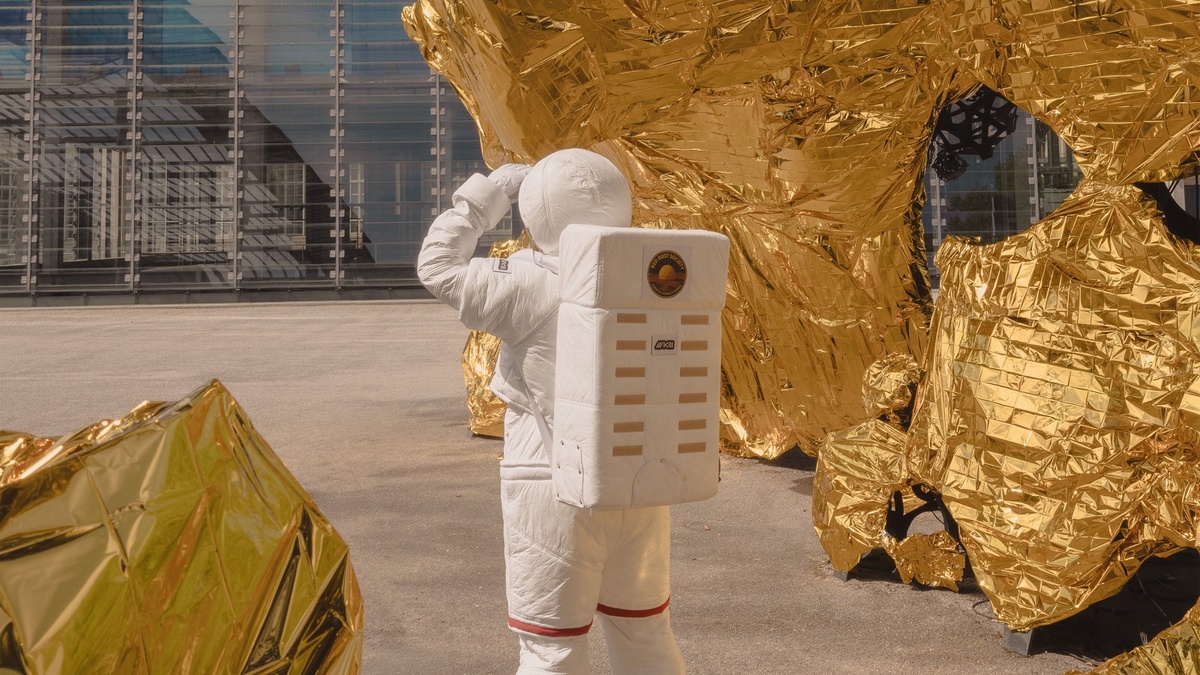
In 2026, we fly to Mars together to save the Earth. In the concept exhibition MARS! we are exhibiting the results and ideas of the five prototype workshops, which show that Mars colonization and what we would need on a climate-changed Earth are not so far apart. The exhibition presents five prototypes that were developed together with citizen scientists from the Red Dust Society in the areas of habitat, mental health, food, governance and resource management. Visitors are invited to actively help shape the exhibition and contribute their own ideas - because all the skills we need for a democratic Mars settlement are also needed here on Earth to create resilient societies.
In the MARS! - Mobilizing Awareness for Resilient Societies! project, the ZKM | Hertzlab, as the future department of the ZKM, has ventured precisely this thought experiment. Instead of staying behind on a burning Earth and watching the rich leave for red climes, we have turned Mars into a project for all of us. In five prototype workshops, scientists and citizen scientists worked together as the Red Dust Society to design and test what Mars migration could look like. In the course of the project, it became clear that all the skills we would need to survive on Mars are also needed here on Earth to prepare us for the consequences of climate change. And so we ultimately fly to Mars to save the Earth, with the knowledge and tools we need to start building a better society today.
The five prototypes
Habitat
What does a MARS! habitat look like? A habitat that can withstand extreme weather conditions is not only essential for survival on Mars. In view of increasing climate extremes on Earth - from heat waves to floods - resilient forms of housing are also in demand here. The prototype shows innovative approaches for modular, adaptable architectures that work both on the red planet and in climate-stressed regions of the Earth. Is your idea missing from our collection? Draw and describe your ideal Mars habitat in the exhibition.
Mental Health
Overcoming the loneliness crisis not only on alien planets: The mental challenges of a Mars mission - isolation, spatial confinement, lack of a natural environment - reflect problems that already affect many people on Earth today. The prototype developed strategies and systems for mental health care that are relevant for astronauts as well as for people in densely populated urban areas or isolated communities. Can robots and machines help us cope with stress and feelings of loneliness? You can try it out in the exhibition.
Food
If the cow doesn't fly to Mars, what do we eat? On a planet without atmosphere, water and fertile soil, food production has to be completely rethought. The prototype has researched sustainable food systems that make do with minimal resources - approaches that are also urgently needed on Earth in view of climate change, water scarcity and a growing world population. In a future banquet, we tasted our way through alternative protein sources from algae to insects and found out what the human organism needs to survive.
Governance
Is it worth exporting capitalism to the red planet? A settlement on Mars would offer the opportunity to rethink social orders: How can we organize communities that also function under pressure? What decision-making structures do we need for a just society? The prototype developed alternative governance models that focus on democratic participation and resource justice - principles that are also fundamental for resilient societies on Earth.
Resource management
Clean water is not a matter of course everywhere on earth. How do we deal with resource scarcity? A recycling system that makes optimum use of resources is not an option on Mars, but a prerequisite for survival. The prototype shows closed-loop systems in which every drop of water and every material counts. These technologies and practices are models for a circular economy, which will also be indispensable on an Earth with dwindling resources and growing ecological pressure.
Participation encouraged
The exhibition is not a closed presentation behind glass, but an open platform. You are cordially invited to test the prototypes, comment on them and contribute your own ideas. Because MARS! is a project for all of us - and the future we are shaping together starts here and now.
Price information:
Museum admission
Location
Organizer




![Eröffnung: [MASTERCLASS] #12](https://imageflow.rausgegangen.de/url/https%3A//s3.eu-central-1.amazonaws.com/rausgegangen/UeIZID5oTWepFeNxq0lN_masterclassweb.jpg?width=384&height=216&mode=crop)


Noch mehr Events dieser Location-Page