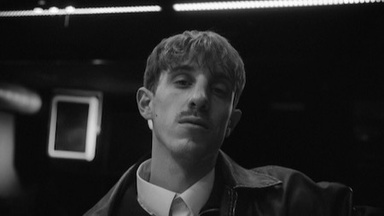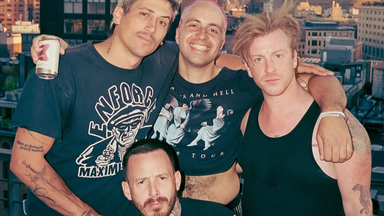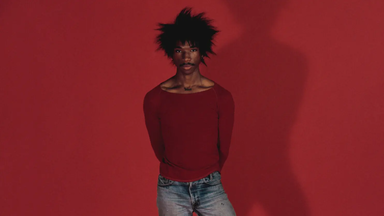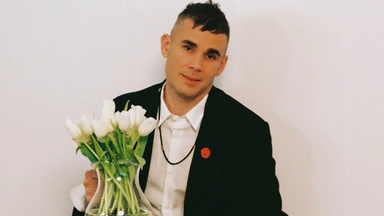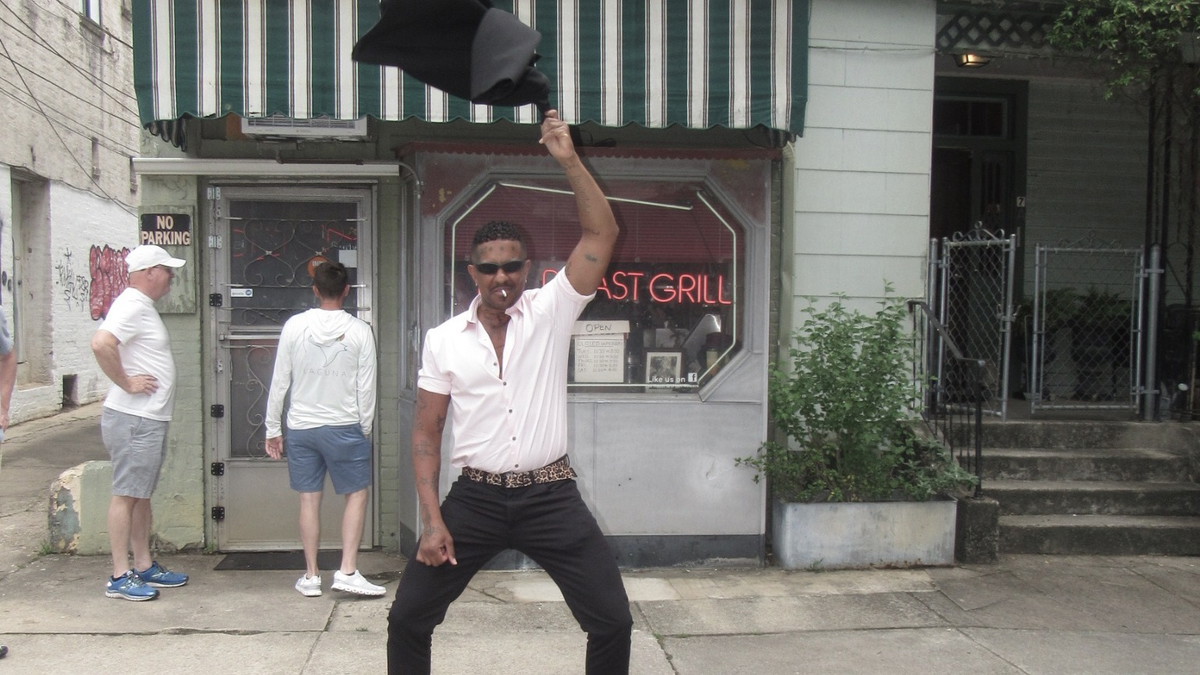
PHOTO: © Friendly Reminder
Mykki Blanco

In the organizer's words:
“If there’s one thing I know how to do, it’s how to get the most out of life. Yeah, sure, not everything is perfect. You screw up. You make mistakes. But hopefully, you’re achieving more than you’re messing up. Overall, I’d say I’m doing well, making the most of life.” — Mykki Blanco
On *Café Paradiso*, Mykki Blanco is completely reborn, trading the persona-driven theatrics of his previous releases for something more introspective and exacting. The record draws from the diverse, mundane, and yet idiosyncratic contexts of the artist’s life on the move: “...shitty Wall Street lunch counters and an endless stream of dive bars in the East Village” in New York; “...drinking beer and playing pool in Belleville; the drink that lasts forever at Les Chope des Artists and Chez Jeanette” in Paris; and “languishing for hours at the tea houses or Café Hafa” in Tangier. From these fragments, *Café Paradiso* assembles a soundtrack for the contemporary, queer flâneur, moving through spaces where being alone does not necessarily mean being lonely. “Café Paradiso is an album for artsy kids,” Blanco explains, “for my cosmopolitan aesthetes to sit alone in a café and work on crafting the life of their dreams, or just make sense of it!” When asked which earlier versions of himself appear here, Blanco is unequivocal: “None.”
If Blanco’s discography exists less as a linear evolution and more as a series of deliberate mutations—each project shifting in terms of tone, genre, and even the function of the voice—then Café Paradiso represents his post-rumspringa clarity. “I love creating music, but I’ve never liked the idea of being a one-trick pony,” Blanco explains, “I need to check some things off my ‘Life List.’” After his 2022 album *Stay Close to Music* and the *Postcards from Italia* (2023) EP, Blanco spent two years at art school in Switzerland, earning his MFA and deepening his studio practice as a visual artist. “I’ve got a lot of ideas for interdisciplinary projects,” Blanco says, “and I felt the experience helped me level up in other areas of my career and expand my knowledge base, which ultimately makes everything I produce even cooler.” In September 2024, Blanco submitted his thesis, “The Black Presence in Early Soviet Russia,” and graduated, then returned to his “first love”—songwriting.
The lead single “Little Feet” (featuring Ian Isiah and Breakaway) sets the tone for the record as a soundtrack for the “wayward metropolitan,” to use the artist’s own words. Blanco and his collaborators purr about hanging out, hooking up, and dancing the night away under the streetlights over a sultry, nostalgic groove that feels both familiar and slightly unreal.
On the second single, the provocative party anthem “Butt Sex,” Blanco calls all his “baddies to the floor” while banishing the “uglies,” turning the album’s sensuality outward—more direct, more mischievous, and openly communal. On the third single—the more restless “NYC DOGS”—Blanco commands listeners to “stick out [their] tongues” like the “bad dogs” they are, and repeatedly invokes the city that inspired and helped bring this project to life: “I chose to record *Café Paradiso* in New York because I wanted to come home for a bit,” Blanco explained, “New York is where I ran away to when I was 16 … where I first began writing music after dropping out of Parsons School of Design, where I published my first book of poetry, and where I launched my career on the underground scene 13 years ago.” He continues: “Café Paradiso is an album for city kids. It’s heavily inspired by New York, but the New York of today—one that isn’t parochial but transatlantic. Café Paradiso is also global. It’s a series of vignettes that speak to the lives lived inside the concrete jungle.”
Together, “Butt Sex,” “NYC DOGS,” and the fourth single, the genre-bending “Easy Does It” (featuring Evanora Unlimited and Simone Alysia), showcase the breadth of Blanco’s collaborative approach, shaped by an international network of artists working across different scenes and sensibilities. At the center of this storm is his longstanding, almost psychic creative partnership with producer and composer Drew “FaltyDL” Lustman. “I’ll probably create music with FaltyDL forever—or as long as he’ll have me,” Blanco says. “Drew really helped me cultivate what I consider to be my ‘true sound’—the sound that defines my identity as an artist now that I’ve reached musical maturity.” The “true sound” Blanco refers to defies easy categorization. Once described as a “magpie-like approach to sound with a casual disregard for genre conventions” (MusicTech, 2023), Blanco’s music operates less as a style than as a method—an aural frottage, or the sonic memoir of an urbane artist assembled from fragments, encounters, and drift. As noted by Pitchfork in 2016, it is “a departure from the brusque heterosexualization of nearly all mainstream rap.”
This approach is epitomized by “FOXES” (featuring Tama Gucci). “I don’t think I’ve ever felt so free,” Blanco says of the making of this song, which begins with the artist introducing himself—midway through his third studio album, mind you—thanking his “amazing band,” expressing his gratitude for the “amazing tour so far,” and giving a shout-out to his collaborators before launching into an incantation-like, nursery rhyme-like refrain with fable-like lyrics. Arguably the emotional and conceptual climax of this album, Blanco cites this track as “the reason I am a musician is to achieve this kind of freedom that elevates my soul into higher art and performance.”
While “FOXES” captures the album at its most expansive, other tracks channel that same sensibility into more defined, genre-specific forms. A song like “Spread 4 Me,” for example, could easily be part of the same lineage as heartland rock classics that exude a certain kind of slick, nonchalant pop Americana. The song is upfront and wholesome—as close to pop as Blanco has ever been—but it hints at something carnal and epicurean lurking beneath the surface with its rallying cry: “Make like butter and spread for me.”
As high-energy as parts of this album might seem, *Café Paradiso* is, at its core, a record about stillness. Blanco insists, “It’s not a point-A-to-point-B record, or a pre-game record. It’s an album about enjoying your own company.” Resisting the logic of escalation or destination, Café Paradiso lingers in transitional spaces—the solitary meal, the late-night bar, the airport terminal—where time stretches and the self becomes momentarily unmoored. What emerges is music attuned to the quiet intensity of being alone in public, where observation becomes its own form of participation.
This dual position—being both observer and participant—harks back to Blanco’s formative experiences on the early Internet. “I literally am who I am today because of how much music I was exposed to via Napster and Limewire, and those thrilling early days of downloading music and blending genres,” he explains. “It’s the same with selecting songs on a jukebox. I love fragments. I love sketches. I’ve always been obsessed with worlds within worlds, and how subplots create a whole.” He continues, comparing *Café Paradiso* to a “three-act play” or a script for a “feature film,” and citing references such as Saint Etienne, The Silver Apples, and Towa Tei. “I mean, this album is pretty eclectic,” Blanco says, “it’s a festival album.”
Café Paradiso marks not so much a break as a refinement in Mykki Blanco’s career. Bringing together years of experimentation across music, performance, and visual art, this album arrives at a moment of fleeting clarity—it is a confident statement of intent, positioning Blanco not simply as a shape-shifter, but as an artist in full command of his current form.
Price information:
+ fees
Location

Organizer | Event Series

You might enjoy this as well?












Noch mehr Events dieser Location-Page