Nomadische Existenz: Queere Präsenz und unsichere Zufluchten
In the organizer's words:
A conversation between author and artist Ju Bavyka and the curator of the collections from North Africa, West and Central Asia, Dr. Melanie Krebs.
Until the late 19th century, identity in multilingual Central Asia was not defined by concepts of nationality. The Soviet Union first founded nations and then united them. Handicrafts - carpets, embroidery, ceramics, clothing - were assigned to newly named nations, exhibited at fairs and celebrated as long as they were in line with state programs.
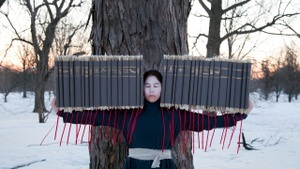
Ju Bavyka, author, artist and 2026 CoMuse Fellow at the Humboldt Forum, lives in Australia and was born in Kazakhstan. Based on her own queer experience, Bavyka looks at objects in the Central Asia collection that defy national and artistic categorization.
Bavyka presents findings from research into the collection and refers to the yurt (a traditional tent of Central and North Asian societies) as the embodiment of a desire to live a nomadic, non-settled life - following the climate and available resources. Yurts are a shared heritage for many societies and ethnic groups and continue to be used - they are structures in transition and places of search.
"My ancestors were nomadic, of course I'm trans," read the poster of a member of the Berlin collective Slaystans at a recent Pride March. Bavyka wants to honor the vibrant Central and North Asian queer community in Berlin as inspiration for this fellowship. Its members challenge exclusion and invent new ways of living, re-appropriating traditional symbols and crafts.
Participants
Ju Bavyka is a writer and visual artist born in Petropavlosk, Kazakhstan and based on Gadigal land in Sydney, Australia. His work spans text, installation, drawing and mediation and explores migration, queerness, labor and structural exclusion. Essays, poetry, and creative nonfiction have appeared in un Magazine, Runway Conversations, Liminal, and InterAlia. Bavyka received the Peter Blazey Fellowship in 2025 and is a 2026 CoMuse Fellow at the Humboldt Forum Berlin. Bavyka is currently working on his*her first book.
Melanie Krebs has been curator for the collections from North Africa, West and Central Asia at the Ethnologisches Museum since 2022. Her research interests include civil society developments and urban culture in Central Asia and the Caucasus since 1991 as well as arts and crafts as carriers of identity.
CoMuse - The Collaborative Museum is an initiative of the Ethnologisches Museum and the Museum für Asiatische Kunst that aims to jointly develop multi-perspective approaches to collection-based research and to test new formats for collaborative processes in order to sustainably intensify the decolonization and diversification of museum practice.
The CoMuse Fellowship program is supported by Künstlerhaus Bethanien, which provides a studio for artistic and scientific research.
Ju Bavyka was a CoMuse Fellow at the Ethnologisches Museum and the Museum für Asiatische Kunst between April and May 2026.
- free of charge
- Duration: 60 min
- from 12 years
- Language: German
- Location: Mechanical arena in the foyer
- Part of: Guest room
This content has been machine translated.Location




Events near you
Activities near you
Popular event locations
The best event recommendations for the Rausgegangen App!
