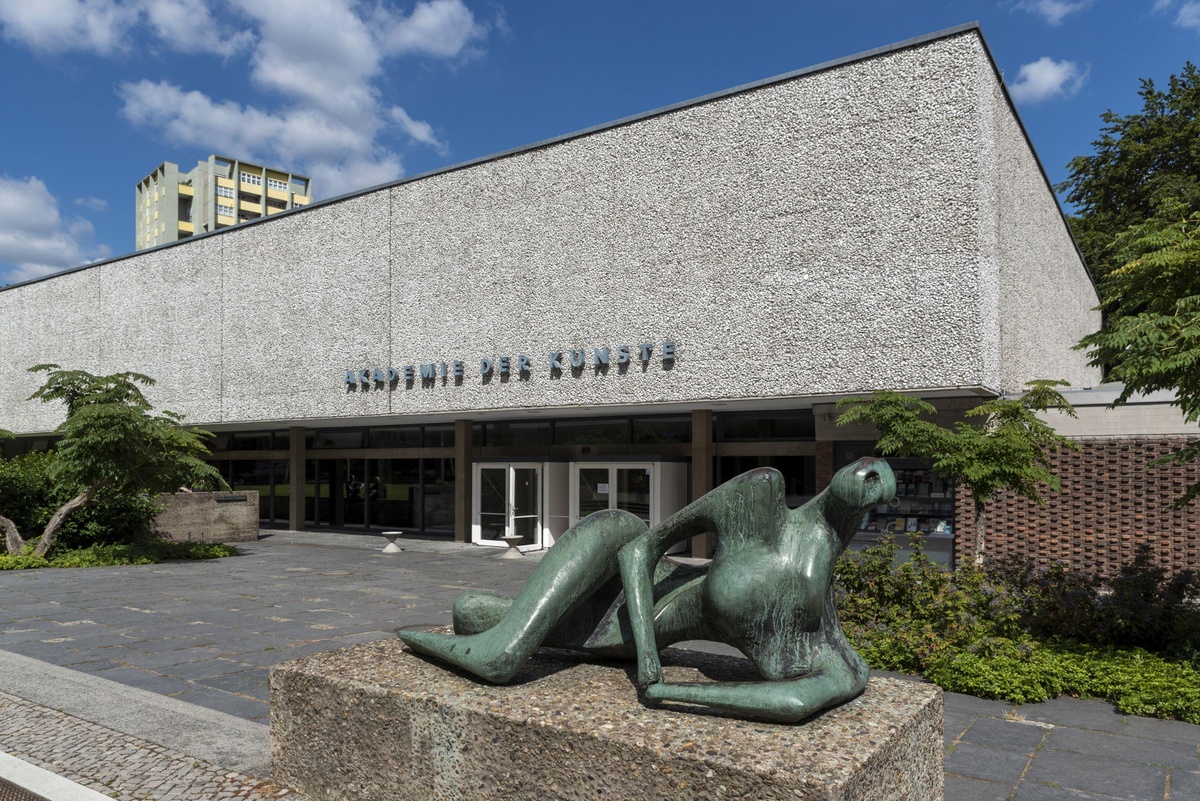
Robert Frank – Filmmaker | Filmprogramm
In the organizer's words:
Robert Frank - Filmmaker
With his photographic oeuvre, Robert Frank (1924-2019) is part of the canon of art history. His films and videos, on the other hand, which formed the focus of his work from 1959 onwards, are still considered a film and art historical secret in many places. With a few exceptions, they are hardly known in Germany. The Akademie der Künste is now dedicating a packed weekend to this work: six cinema screenings with 14 selected Frank films and, as a prelude, Laura Israel's wonderful film about the artist.
Frank was born in Zurich and trained as a photographer, but emigrated to New York in 1947. His "otherness", which he had felt strongly in the confines of Switzerland and not least because of his Jewish origins, remained a defining characteristic for him in the USA. His 1958 photo book The Americans provided a sensational contrast to the American self-image; the film work that began immediately afterwards made Frank's distance from the "establishment" even clearer. His way of life (from 1970 onwards, mostly in the harsh isolation of Nova Scotia, Canada) and his artistic quest overlap: in his resistance to everything polished and formulaic, in his attempt to create a cinematic realm for the so-called weirdos and outsiders, their underworlds and secondary worlds, which transcends the usual categories.
Documentary, fictional, essayistic, experimental - diary, autobiography, cinéma vérité, fantasies - in short and feature-length: Frank's cinema touches on these categories in different ways and belongs to none of them. The characters in these films are also radically open. They include himself, his relatives and his letter carrier, as well as celebrities who crossed his path or helped shape it: from the Beat poets Allen Ginsberg and Jack Kerouac (who contributed the voice-over narration to Frank's first film Pull My Daisy in 1959) to the Rolling Stones, whose backstage reality he captured in Cocksucker Blues in 1972 (which did not sit well with the band - and meant that the film was rarely allowed to be shown).
Frank remained unavailable, just like the webs of reality he sought to capture. In his late masterpiece The Present (1996), we see a written image: "Memory" - and how it is painstakingly erased. Then we hear Robert Frank's voice: "I lost. So what? That's the question."
Curated by Alexander Horwath & Regina Schlagnitweit
2024 is the hundredth birthday of Robert Frank
The program
Saturday 2.3.
4 pm
About Me: A Musical (1971) b/w, 30 min
Don't Blink (2015) by Laura Israel, b/w, 82 min, original version with German subtitles
A short, wry, doubtful self-portrait, followed by a confidante's loving look at two decades of close collaboration. Robert Frank says almost defiantly in and about About Me: A Musical: "My project was to make a film about music in America. Well, fuck the music. I just decided to make the movie about myself. And this here is the young lady playing me." In an artistic act of liberation, the work commissioned by the American Film Institute is thrown overboard - and the central question ("What should you make a movie about?") is passed on to the street, to the audience. 44 years later, Frank's editor and archivist Laura Israel is making a feature-length film about him. He has retained his stubbornness even as a ninety-year-old, but clearly feels comfortable as a raconteur of his own story. "Don't Blink!" - because there would be too much to miss in this cabinet of curiosities full of rare film clips, memories and photographs, embedded in a network of accomplices. On the soundtrack, the New York pulse beats from Velvet Underground (European Son) to Tom Waits (Hang on St. Christopher). Hang on, St. Robert!
6:30 p.m.
Conversations in Vermont (1969) b/w, 26 min
Life Dances On(1980) b/w and color, 32 min
The Present(1996) color, 23 min
How can cinema say "I"? And how does this "I" exist in the great mosaic of family, friendship and the world? Between 1969 and 1996, Frank made a kind of film trilogy about this: far removed from any autobiographical rounding off, open to all crises - including those of artistic practice. The past is always present, and the questioning of others always serves to question his own world view. In the conversations in Vermont, a "family album", Frank and his children Pablo and Andrea try to fathom growing up in the bohemian world. By 1980, Pablo wants to go to Mars - and Andrea is dead, as is Frank's best friend Danny Seymour. On "Skid Row" in New York, he meets a guy who has to attack everything. Where does the thread to the world begin, where does it end? "I'm 55 years old, I gotta do something," says Frank and tries to photograph the wind, in color. The Present ultimately becomes the unpretentious sum of his work - a seemingly loose diary that represents the perfect balance between Frank's personal ideas of "order" and "randomness". The places, people, motifs of his life and art all haunt this film and never come to rest. His animal companions in Nova Scotia and the views through the window pose further questions: Where is the threshold between inside and outside?
8:45 p.m.
Pull My Daisy (1959) by Robert Frank and Alfred Leslie, b/w, 28 min
Energy and How to Get It (1981) b/w, 30 min
Paper Route (2002) color, 23 min
Moving Pictures (1994) color, silent, 17 min
The framework of this program is formed by two works that are representative of Robert Frank's (temporary) rejection of and reapproach to photography. The words of Jack Kerouac can be heard and seen as a bridge. "Early morning in the Universe" - In 1959, Frank and his Beat Generation buddies planted a film in the landscape with Pull My Daisy, which co-founded the New American Cinema and (also through the participation of Delphine Seyrig) began a dialog with the Nouvelle Vague. The play-within-a-play of Ginsberg, Corso & Co. and Kerouac's spoken improvisations on the soundtrack are equally exuberant, shirt-sleeved and in search of meaning. 35 years later, Moving Pictures shows Kerouac's words in due silence: "Lonesome traveler ... the forlorn rags of growing old." The middle section of the program examines two more offbeat or "marginal" life plans - and, quite characteristically for Frank, the most idiosyncratic forms of verbal and cinematic speech. Energy and How to Get It, an idiosyncratically wild ride through Wendover, Nevada, begins as a supposed portrait of ball lightning researcher Robert Golka, before William S. Burroughs as the "Energy Czar" and Robert Downey as a "Hollywood agent" hijack the scene. Two decades later, Frank is winding through his home terrain in Nova Scotia on the Paper Route. Fueled by the eternal question: "How to live your life?", he accompanies newspaper delivery man Bobby McMillan on his snowy drives through the dawn. At the end, the dialog: "How do you like to be filmed?" - "Good!"
Sunday 3.3.
4 pm
Tunnel (2005) b/w and color, 4 min
Me and My Brother (1965-68, re-edited 1997) b/w and color, 91 min
In his first feature-length film, Robert Frank explores the zones of the "real" and the "unreal". What actually takes place, what happens "only" in the imagination? Where does sheer existence become a game? And who the hell is the "Me" in the title? Me and My Brother - like Shirley Clarke's Portrait of Jason or Jim McBride's David Holzman's Diary - belongs to the family of meta-truth movies that questioned the claims of cinema vérité and direct cinema in the late 1960s. Frank's protagonist is Julius Orlovsky, a catatonic whose motor behavior oscillates between extreme excitement and passivity. Together with his poet brother Peter and his lover Allen Ginsberg, Julius wanders through Lower Manhattan. During a cross-country trip to Kansas and San Francisco, he disappears - the actor Joseph Chaikin has to stand in for him. Frank orchestrates the clash between different concepts of truth in cinema with verve (and with Sam Shepard as co-writer). The very young Christopher Walken takes over Frank's part (with his voice), and at one point Allen Ginsberg declaims: "Truth breaks through!" Truth" also plays an uncomfortable leading role in Tunnel, Frank's most mysterious film: the slaughter of a bull to the music of Wolfgang Amadeus Mozart.
6 p.m.
Home Improvements (1985) color, 24 min
Candy Mountain (1987) by Robert Frank and Rudy Wurlitzer, color, 91 min, original version with German subtitles
La vie de Bohème, and how they are mutually dependent: life as an artist and private entanglements. Home Improvements is Frank's first video work, shot with a semi-professional Portapak camera between November 1983 and the end of 1984. An "everyday film" between New York City and Mabou, Nova Scotia, the contrasting retreats of Frank and his wife, the painter and sculptor June Leaf. Frank is 59, his son Pablo is in a psychiatric ward, June is hospitalized. The fog and the winter sun of Mabou burn themselves in, and Frank destroys a whole stack of his photos with a drill. Around the same time, he develops his only "classic" feature film with the writer Rudy Wurlitzer: Candy Mountain is stylistically the antithesis of Home Improvements, but secretly related. A dreamy-eyed musician is given the task of finding the best guitar maker in the world, who has disappeared. On the way to Cape Breton, Nova Scotia, he meets strange birds like Joe Strummer, Tom Waits, Dr. John and Bulle Ogier - and in the end, in the encounter with his target, realizes that in art (including that of guitar making), erasure can be just as important as "making". In J. Hoberman's words: "In a way, this shaggy-dog hipster road film is Frank's ultimate work - evoking the end of the road and even the end of Endsville - but he has persevered."
8.45 pm
Cocksucker Blues (1972) b/w and color, 89 min
As a prelude: Surprise Film b/w, 8 min
"Except for the musical numbers, the events depicted in this film are fictitious. No representation of actual persons and events is intended." - So is Cocksucker Blues another deconstruction of the truthmovies? Or can the opposite be said: that American documentary film has rarely conveyed its subject so closely, so directly, so bluntly? Even if the Rolling Stones are still not happy about the film being shown today, they cannot deny its sheer existence. When the band and Robert Frank met, there was nothing but mutual admiration. Frank contributed a photo collage for the album cover of Exile on Main St.. And the Stones invited him to document their first North American tour since the Altamont disaster on film, perhaps even to "celebrate" it. They probably didn't realize that Frank had already clearly demonstrated his disinterest in the high-glam life with the famous photo book The Americans. Despite the adverse, uncooperative circumstances, the filmmaker subsequently carved out his own narrative. Shabby, dirty, rough, stodgy - for Jim Jarmusch, Cocksucker Blues remains a revelation, a disillusionment: "It makes you think that being a rock star is one of the last things you'd ever want to do."
Price information:
Day ticket € 12/8
Location










Events near you
Activities near you
Popular event locations
The best event recommendations for the Rausgegangen App!
