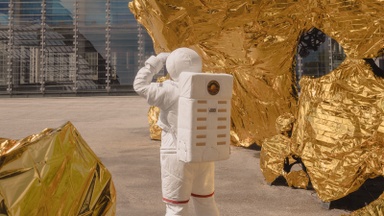
PHOTO: © © Justine Emard, ZKM | Karlsruhe, Foto: Joe Miletzki
Ethik für Innovationen: Wie gelingt ethische Innovation im 21. Jahrhundert?
Do, 24. Sep 2026
10:00 - 12:30
Karlsruhe

In the organizer's words:
Artificial intelligence, quantum, neuro, and biotechnologies are often already in use long before the rules governing their use have been established. Who decides which technological developments are desirable and where the boundaries lie? To mark its 75th anniversary, the German UNESCO Commission is discussing this question at the ZKM—with experts in technology assessment, legal philosophy, and international cooperation.
The conference is taking place in cooperation with the Institute for Technology Assessment and Systems Analysis (ITAS) and the ZKM in the UNESCO City of Media Arts in Karlsruhe.
Whether new technologies strengthen human rights and dignity and contribute to environmental protection, or have consequences ranging from ambivalent to harmful, depends both on their design and on how and in what context they are used.
However, understanding technological developments, shaping them ethically, and steering them politically is becoming increasingly difficult. Technological progress is accelerating; companies operate globally and are gaining influence; and data and value chains transcend national borders. At the same time, the government’s ability to regulate is coming under pressure—for example, due to demands for less regulation and greater risk-taking.
Germany has a robust research landscape and numerous institutions dedicated to scientific policy advice and technology assessment—such as ITAS at KIT and the Office for Technology Assessment at the German Bundestag. But even these structures face challenges: How can their findings have a meaningful impact on society, and how do they find their way into practice?
Moreover, many questions regarding technological change can no longer be answered at the national level alone. The secure and ethical handling of data, or the market power of a few large technology conglomerates, requires international cooperation. In recent years, UNESCO has demonstrated that common ethical principles can be formulated at the international level—in 2021 with its recommendation on the ethics of artificial intelligence, and in 2025 with its recommendation on the ethics of neurotechnology.
What future scenarios are currently emerging with new technologies, and what do they mean for our lives? What options exist for shaping them socially and politically?The morning session will bring together diverse perspectives on these topics: from technology assessment and quantum technologies to the role of art in social discourse, and the question of how ethical guidance can be translated into political and regulatory practice.
Location

Accessibility information
We don't have any accessibility information for this event.
You can find everything about accessibility at Rausgegangen here.
You might enjoy this as well?













Noch mehr Events dieser Location-Page