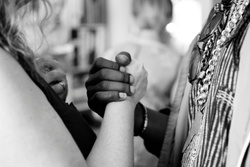
PHOTO: © United Against Racism
Open Air: SOLIFEST - OLDENBURG GEGEN RASSISMUS
In the organizer's words:
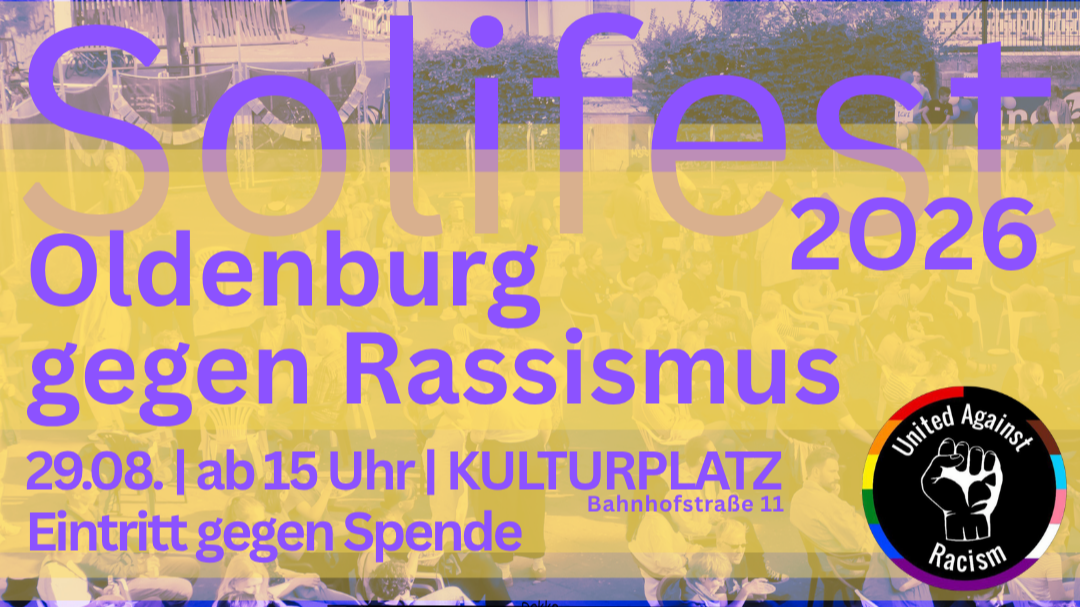
SOLIFEST - Oldenburg Against Racism
Starting at 3:00 p.m.
Solidarity is something to be lived! Solifest 2026 invites you to a reading with Alice Hasters, music, film, discussions, activities for kids, and more at the KULTURPLATZ—for empowerment, connection, and support for local anti-racist organizations. Come on by and join in!
More info coming soon...
Admission by donation to Pena.ger and the Anti-Discrimination Office at IBIS e.V.
Short film starting at 8:45 p.m.:
What’s Coming, What’s Not [Whether I Come or Go] – Letters from Kantstraße 104a
This docu-fiction explores the question of what memories remain of a transient place like an asylum shelter long after people have moved on. What traces are inscribed in the building that point to the life and vitality in the liminal space of flight? On what basis does memory rely when, for example, letters no longer exist because they were lost during the war years?
In July 1983, the ethnic tensions that had been simmering for years in Sri Lanka escalated further, erupting into violent riots targeting Tamils. As a result, thousands of Tamils fled. One of the migration routes took them via East Berlin’s Schönefeld Airport to West Berlin. Once in West Berlin, they were housed in asylum shelters.
The Pension Kant at Kantstraße 104a in the West Berlin district of Charlottenburg served as housing for Tamil refugees from around 1980 to 1989. Spread across two floors, about 60 people lived here for varying lengths of time: women arrived via human smugglers, men came from politically radicalized parties, nationalists met internationalists—and they brought these political tensions with them to the Pension Kant. Some stayed for just one night without applying for asylum; others stayed for several days, weeks, or months before continuing their journey to western Germany, England, France, or even Canada; for some, it marked the beginning of their life in Berlin. A few found allies in West Berlin’s vibrant political scene. They worked as newspaper carriers; they cleaned in restaurants. Together they celebrated parties, followed the burgeoning war in Sri Lanka from their exile in Berlin, and received letters bearing news of the deaths of their relatives. Here, marriages were contracted, families were started, and children were born.
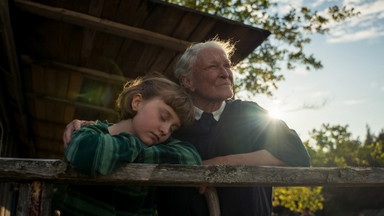
The film reconstructs the experience of that time. Fictionalized letters, based on interviews and conversations with former Tamil residents of the building, offer insight into their inner worlds. In the letters, what transpired between the residents and the filmmaker—the daughter of former residents—during the interviews merges into a subplot. Second-generation Tamils, who now live in Berlin, lend their voices to the film, thereby creating resonances with their own experiences and memories. Their voices alternate between Tamil and German, blending with both the echoes of the archival footage and the soundscape of the building. Film footage of the building as it stands today and photographs of its former residents, when superimposed, reveal the multi-layered nature of space, time, and memory.
Forty years after the 1983 “Black July” [Black July] of 1983, this docu-fiction contributes to situating the memory of the Tamil exodus to Berlin and Germany. It connects the experiences of different generations, encourages reflection on the presence of the transient, and advocates for viewing liminal spaces—such as an asylum shelter—as places teeming with life.
A collaboration between United Against Racism Oldenburg, femref Oldenburg, Cine k, and many other supporters.
Price information:
Admission by donation to support Pena.ger and the Anti-Discrimination Office at IBIS e.V.
Location
Accessibility information
We don't have any accessibility information for this event.
You can find everything about accessibility at Rausgegangen here.
You might enjoy this as well?




Noch mehr Events dieser Location-Page